Sunday, August 04, 2013

‘Aatidonji Dina’ Unique Monsoon Festival of Tuluvas

Aati Kalenja pic by: Ram Naresh Manchi
This is an excerpt from my articles and pictures on ‘Aatidonji Dina’ or a day in Aati month celebrated at Pilikula Heritage Village in the years 2008 and 2009.

Aati(Aashaad)is the month during monsoon season when heavy downpour of rains incite enthusiasm among the hard working Tuluvas of the undivided Dakshina Kannada districts of Karnataka state. They indulge in farming, rain sports and cultural activities with a wide spread of monsoon delicacies to greet the month that ensures their well being.
On Aati Amavaasye(New Moon Day), Tuluvas prepare and drink ‘Pale Ketthe Kashaaya’, a medicine that clears many ailments of the digestive system, purifies blood and builds up immunity according to belief.


‘Aati Kalenja’ the folklore of Tuluvas is the main attraction during the Aati month now confined to rural places, and not many urban dwellers get a chance to watch it now a days due to modernisation. Normally adolescent children are prepared with typical dress made of palm and tender areca leaves, their faces painted and a drummer goes along with the Aati Kalenja singing ‘Paaddana’ or folk songs while the Kalenja dances in a front and back slow motion rotating the umbrella made of coconut leaves. During my younger days, I have seen them every year and women mostly used to accompany them with the drum and singing.

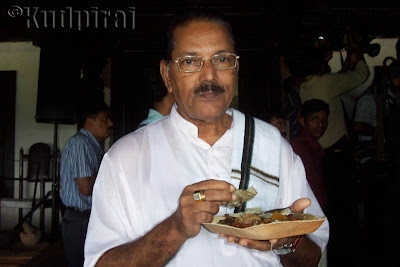


Rains greet the well attended gathering at Pilikula Heritage Village as ‘Aatidonji Dina’every year as Dr Vamana Nandavara, the man in charge of the Heritage Village at Pilikula takes the pain to arrange a food festival showcasing Tuluva delicacies within the Gutthu House.


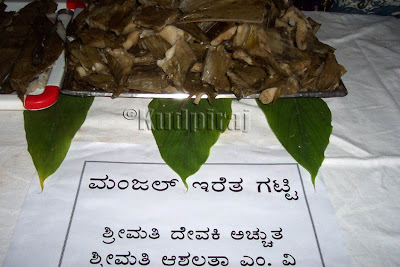


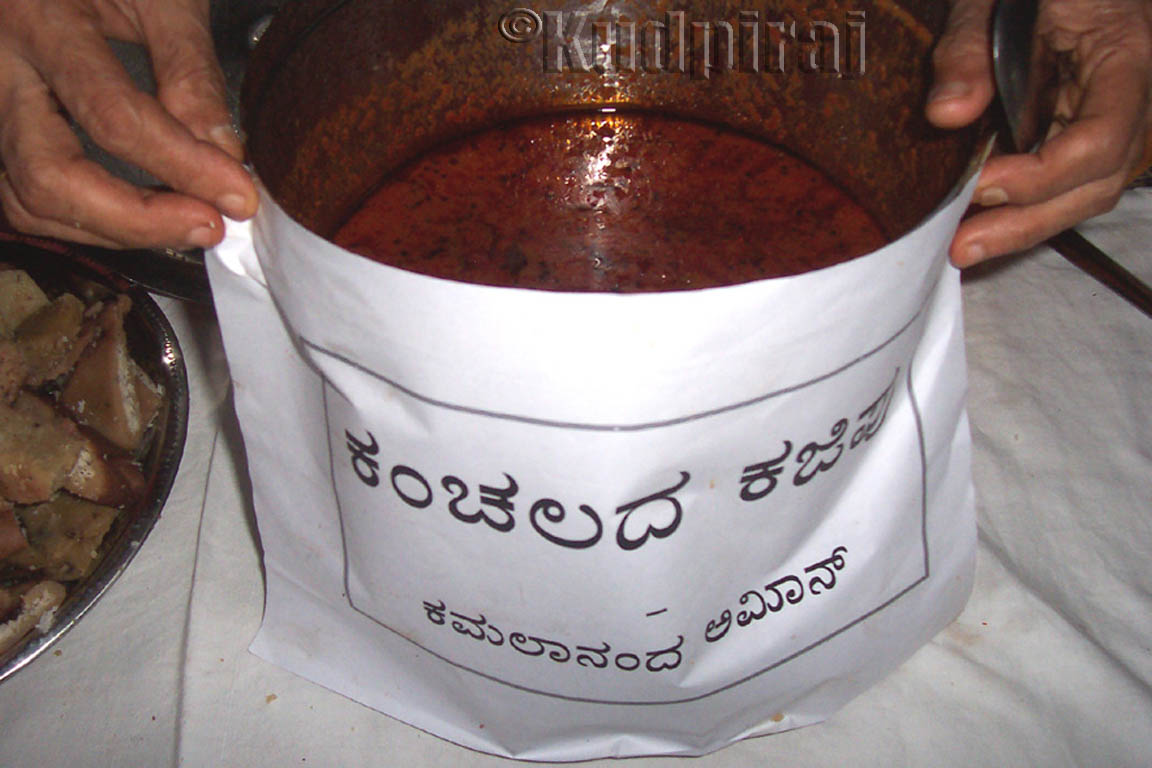
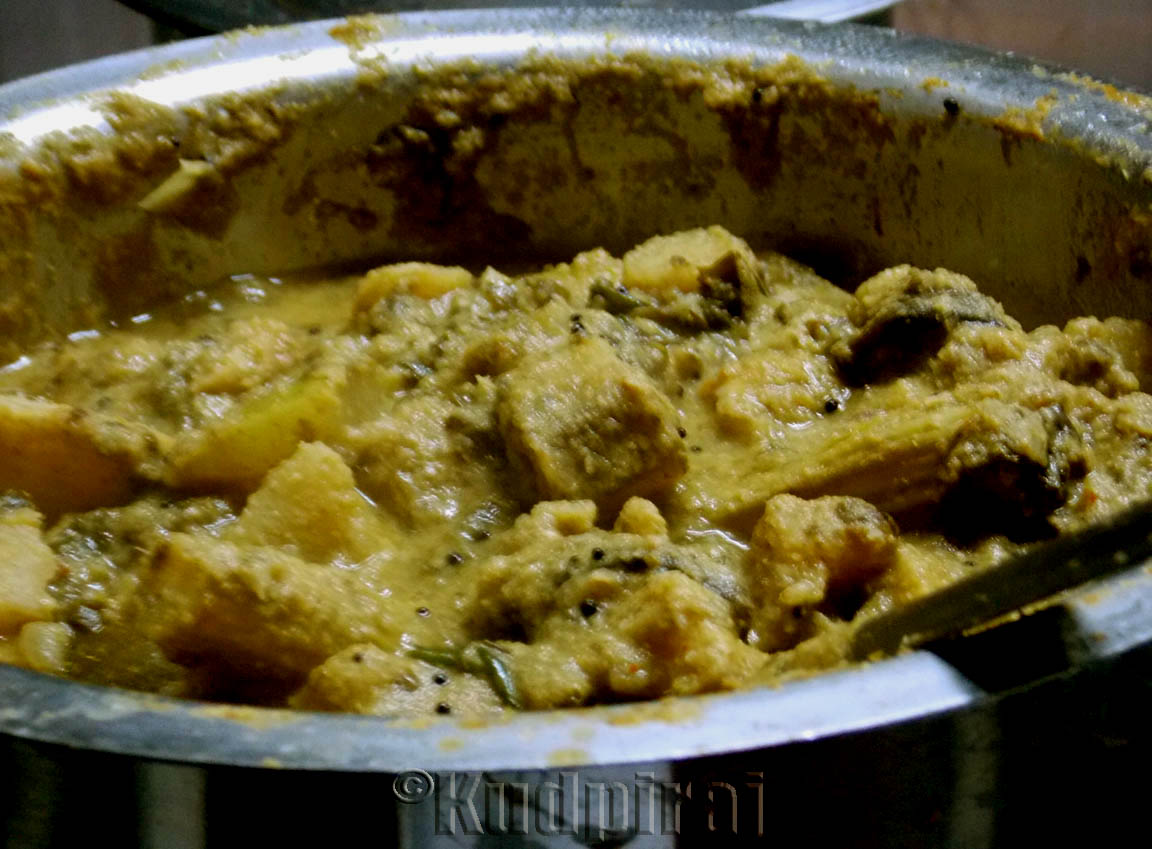
Food specialties included Aritha Pundi, Gujjeda Happala, Thevuda Chutney, Kudutha Saar, Thetlada Kajipu, Uppad Kukkuda Chutney, Nurge Thoppu Ambade, Kudutha Chutney, Kanile Padenji Ghasi, Thekkareda Adye, Pathrode, Manjal Iretha Gatti, Saarnadye, Kanchalada Kajipu, Pelakaayida Gatti, Pelakaayida Gaari, Mambala and a variety of Kashayas that tickle the taste buds of connoisseurs.


Enthusiastic Ladies Group prepares and presents the ‘Aati’ food specialties. The two consecutive years of Aatidonji Dina went by fast enough but the taste of goodies that we tasted there linger on forever!

Friday, July 19, 2013

Kunve Pittaa Duddali - One more Aashaad Ekadashi specialty

Kunve peet is nothing but Arrowroot powder available universally. Our ancestors passed on the traditional way of making a light, non-greasy healthy pudding processing this powder with milk and sugar. For flavouring they added cardamom powder and thus Duddali is born. Duddali is also called as Manni by local Brahmins but they make it mostly with millet, adding jaggery.
Today, duddali is made in many ways. Modern generation is adept at innovations and I have seen some able young cooks formulating duddali with added fruit juices. My mother always made Kunve Pittaa Duddali for Aashaad Ekadashi other than Gajbaje, Rulanva Idli and Chapathi.

We tried this for the first time with the help of Vinaya Shenoy, our good neighbour. The result is encouraging. This duddali can be made without much effort. We have added saffron and garnished the duddali with fried cashew bits for added taste and flavour.

Ingredients:
Kunve Peet - 1 cup
Water - 2 cups
Milk - 1 cup
Sugar - 3/4 cup
Cardamom powder - A pinch
Cashew bits fried with ghee - A handful
Saffron - A pinch soaked in 1 tbsp hot milk
You can also add raisins.

Method:
Mix kunve peet with enough water, filter and allow to stand for 2-3 hrs.
Discard the water settled above and mix sugar, 2 cups water and milk.
Heat a kadai and on slow fire, keep stirring the mixture till it starts to solidify a little like gum.
Mix saffron and cardamom powder.
Apply ghee on a platter and spread the cooked mass.
Garnish with fried nuts and raisins.
Allow to cool and then cut into square or diamond shape.
You can store this in the fridge and consume within 48 hours.

Gajbaje - The Aashaad Ekadashi Special GSB Curry


My mother used to say that during the vanvaas, Pandavas were thriving on vegetables grown in the dense rain forests like Bamboo shoots, yam, taro leaves, amaranthus stem and leaves, Chinese cucumber, Jack fruit seeds etc to make curries. During the Aashaad Ekadashi the fasting day for Hindus, Bheema came out with this curry Gajbaje, a mixed vegetable curry. Perhaps that's why Aashaad Ekadashi Upvaas(fasting) is also known as 'Bheem Paas'.

Whether it is true or not, we GSBs always made use of available vegetables wherever we settled down! The monsoon vegetables are abundantly available in the market. Traditional way of making gajbaje has a coconut based bland masala ground on the grinding stone cooked with boiled mixed vegetables and a seasoning of mustard seeds and curry laves add to the flavour and taste. Slight tang is preferred which can be managed by adding Aambade(Amte Kaayi or Hog Plums). If you don;'t get hog plums, you may add a pinch of tamarind.

Many make gajbaje adding roasted urad daal and coriander seeds but I like it simple with a basic masala as shown in the recipe. Gajbaje can be eaten with Rulaanva Idli(Semolina Idli) or with Chapathis. Ekadashi being an auspicious day calls for no rice, no garlic and onion added in food. On a funny note, some call this curry complan because it has all the essential ingredients that are fortified with vitamins, minerals and fibers.
Ingredients:
Grated Coconut - 3/4(or 3 cups)
Red chillies - 6-7 roasted
Salt - To taste
Keerlu(Bamboo shoots) pieces - 1 cup
There Paan(Taro Leaves) - 15-20 palm size
Bikkand(Jack Fruit seed) - 1 cup(peeled and cut into 2)
Magge(Chinese/Yellow Cucumber) pieces with skin - 1 cup
Bhaajji Dento(Amaranthus stem)(or Drum Sticks) - 1 shaved and cut into 2" pieces
Soornu(Yam) - peeled and cut into 1 cup cubes
Potato - 1 medium cubed
Aambado(Hog Plums) - 3-4 cut into big pieces/crushed, or a pinch of tamarind
Coconut oil - 1 tsp
Mustard seeds - 1 tsp
Curry leaves - 1 sprig

Method:
Grind coconut and red chillies to a smooth masala paste.
Soak Bamboo shoot pieces in salt water for 2 consecutive days and discard the water. Boil with salt and water and drain.
Roll the taro leaves between your palms like  a cigar and tie a knot. This is called There paannaa gaanti.
Boil the gaantis with other vegetables adding little salt till well cooked.
Add the masala paste, boiled bamboo shoots and bring to a boil.
Allow to simmer for 5 mins.
Check for salt.
Heat oil in a small kadai, add mustard seeds and allow them to splutter, add curry leaves and fry them.
Pour this seasoning over the curry, mix and serve.

Note:
You may also add other vegetables like Bread Fruit, Kantola, Parval, Gherkin and Pumpkin but my preference is limited to above listed vegetables, as I am used to that way since my mother used to make Gajbaje.

Wednesday, July 03, 2013

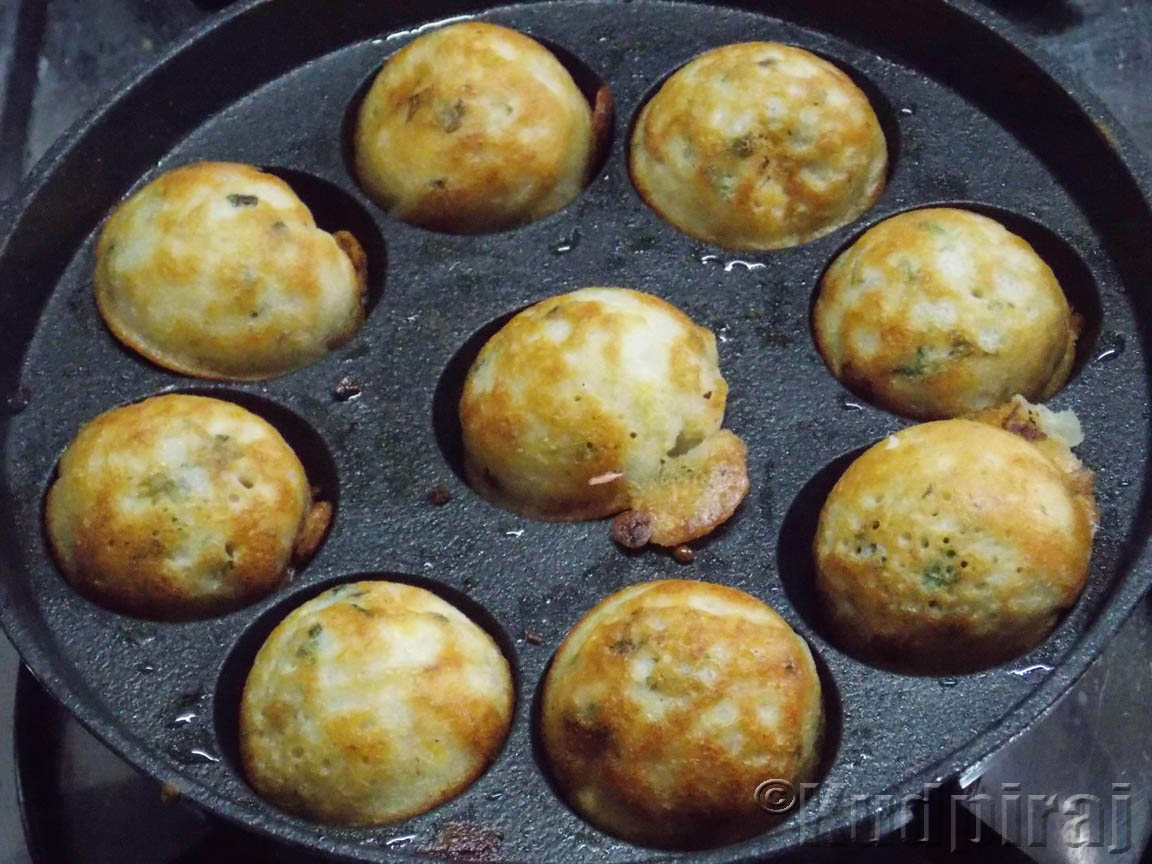
Guliappa with a Twist!(Two Lentil Aappo)

Guliappa, Aappo or Paddu as this is called in different parts of Karnataka, is a popular breakfast snack. It can be made in different ways. Though it is customary to use only Urad Daal in aappo with or without added rice, recently, a friend passed on a wonderful recipe to make soft tasty and nutritious aappo with two lentils, namely urad Daal and Chana Daal.
This has ginger and chillies in it, which normally kids hate but they are so cleverly used, nobody can make out their presence but only their subtle flavour and taste! Make these on a rainy day and you may be tempted to skip lunch and have these with sambar or some nice curry!

Ingredients:
1. Rice - 2 cups
2. Urad Daal - 1 cup
3. Chana Daal - 1/4 cup
4. Salt - To taste
5. Soda Bicarb - A pinch
6. Oil/Ghee - Sufficient for seasoning and roasting
7. Onions - 3-4 medium chopped
8. Green Chillies - 4 Chopped
9. Ginger - 1" piece grated
10. Coriander Leaves - A small bunch chopped
11. Curry Leaves - A sprig chopped
12. Asafotoeda - A pinch

Method:
Soak rice and the two daals separately for 2-3 hours.
Drain and grind separately.
Grind urad daal to a smooth paste
Grind rice and chana daal coarsely.
Mix all the batter together and ass salt and a pinch of soda bicarb.
Prepare a seasoning with ingredients 7 till 12.
Add the seasoning to the batter and mix well.
Allow to ferment for 2-3 hours and then prepare aappos in greased aappo pan.
Roast well on both sides and serve with any coconut based chutney or sambar.

Tuesday, July 02, 2013

Daal Paalak(Lentil and Spinach curry)


Daal Paalak with Phulkas
"Daal Roti khao...Prabhu ke gun gao....".
Thus goes a Hindi film song of the seventies. This song has reality and it depicts the need of the average Indian to satiate hunger. Daal Roti is the staple food of Indians, especially living in the North.

Lentils play an important role in Indian cooking. Tuvar daal, Moong daal and Chana daal are popular while Masoor daal, Chowli(String Beans) and Rajma are also cooked to make excellent daal curries. A mixture of two or three daals is ofter seen in Maa Ki Daal or Daal Makhani.

This Daal Paalak is a healthy alternative to many other kinds of daal curries. It has the proteinfrom Moong Daal, Vitamins from Paalak and digestive/neutralising substances through Onion, Ginger, Garlic, Turmeric powder, Cumin seeds and Asafotoeda. Slight tanginess is achieved with a squeeze of lemon.

This can be eaten with plain steamed white rice, idlis, shevai, chapathis, rotis, phulkas and any Indian flat bread. Can also be consumed like soup.

Ingredients:
Moong Daal - 1 cup
Paalak - A small bunch
Cumin seeds - 1/52 tsp
Asafotoeda - 2 pinch
Turmeric powder - 1/4 tsp
Onion - 1 medium chopped
Ginger - 1" piece chopped
Garlic - 5-6 cloves peeled and chopped
Green chillies - 2-3 slit lengthwise
Salt - To taste
Oil or ghee - 1 tsp
Lemon - 1/2

Method:
Wash and cook daal with little salt, a pinch of asafotoeda, little turmeric powder and 2 cups of water.
Clean, wash and chop paalak.
Heat oil in a pan, add cumin seeds and allow them to splutter.
Add another pinch of asafotoeda, remaining turmeric powder, onion, garlic, ginger and green chillies.
Fry till the raw smell disappears.
Add the chopped paalak and fry.
Add the cooked daal with water and salt to taste.
Bring to a boil, cover and simmer till paalak is cooked.
Squeeze as much lemon as you want.
Serve hot.


Monday, July 01, 2013

Keerlaa Neli Sukkhe(Tender Bamboo Shoot Dry)

With inputs from: Nisha Baliga Shenoy

Bamboo Shoots(Keerlu/Kanile) are easily available in the monsoon season. Mangaloreans crave for these and make delicious preparations like curries, pickle, fritter and savoury dosa. Mainly three parts of the bamboo shoot are used in cooking. The tender tip is chopped and this is called Keerlaa Neli. the very next portion below the neli is used in pickle made with hog plums(Ambade/Amte Kaayi). The fibrous portion is the Keerlu used in other curries and is preserved in brine. Dry curry(Sukkhe) made with keerla neli is a GSB specialty.


Keerla neli is available in some markets. It is soaked in plain or salt water for a day or two to remove the pungent odour and bitter taste. A masala paste with grated coconut, chillies and other ingredients is ground and cooked along with keerla neli and chopped jack fruit seeds, seasoned with mustard seeds to make sukke. This is my personal favourite and my mother made the best sukke as far as my experience goes.

This sukkhe can be served with rice and rasam, daalithoi, congi or with chapathis.

Keerlaa Neli Sukkhe
Ingredients:
Keerlaa Neli(Tender Bamboo Shoot chopped) - 2 cups
Jack Fruit seeds - 1 cup chopped and soaked in water for 30 mins.
Grated coconut - 2 cups
Red Chillies - 4-5 roasted with little oil
Urad Daal - 1 Tsp roasted with little oil
Tamarind - A pinch
Powdered Jaggery - 2 Tbsp or little more
Salt - To taste
Coconut oil - 2 Tsp

Keerlaa Neli
Chopped Keerlaa Neli
Method:
Grind grated coconut, tamarind and red chillies to a coarse paste.
Add roasted urad daal and grind further till urad daal gets well blended with the masala.
Cook keerlaa neli in salt water till tender. Drain and keep aside.
Take the chopped jack fruit seeds with the masala paste, powdered jaggery and little water in a pan.
Bring to a boil and simmer till jack fruit seed is cooked.
Open the lid, raise the flame and add the cooked keerlaa neli and salt to taste.
Allow the curry to get dried.
Keep mixing, so that the curry doesn't get burnt.
When the sukkhe is thick and dry, switch off the flame.
Heat oil in a small kadai and prepare a seasoning with mustard seeds.
Pour this seasoning over the curry and mix well.

Sunday, June 30, 2013

Alaambe Aambat(Thunder Mushroom Ghashi)

GSBs just love Alaambe Aambat. This is a bland sweetish curry with or without added Yellow Cucumber. Adding Yellow Cucumber gives the curry added taste and flavour. Every GSB house hold that prepares alaambe in the season goes for this curry which is liked by all age groups. This is also a monsoon time delicacy and goes well with rice and rasam or daalithoi, congi, idlis and chapathis.
Alaambe Aambat
Ingredients:
Alaambe - 1 KG washed cleaned and shelled
Yellow Cucumber - 100Gm piece peeled and chopped into small bits.
Grated coconut - 2 cups
Roasted red chillies - 4
Tamarind - A small ball
Onion - 2 medium
Salt - To taste
Coconut oil - 2 tsp
Raw Alaambe
Peeled Alaambe
Method:
Grind roasted chillies and tamarind along with grated coconut to a fine paste.
Cook the chopped yellow cucumber and the chopped onions with very little water.
Add the ground masala and salt to taste.
Bring to a boil and cook for 12 mins.
Now add the alaambe and cook for another 3 mins.
Switch off the flame.
Heat oil and add the remaining chopped onions.
Fry till golden brown and pour this seasoning over the curry.
Serve hot.
Alaambe Aambat ready for serving
Alaambe Aambat with Paan Pole

Alaambe Bhutthi(Thunder Mushroom Bhutthi)

Alaambe bhutthi is typical GSB curry with the goodness of coriander seeds in a coconut based gravy. This again is a monsoon favourite and tastes fantastic with rice and daalithoi, congi, idlis and chapathis. I also eat this with bread or paav bun sometimes.

For shelled alaambe picture click here.
Alaambe Bhutthi
Ingredients:
Alaambe - 1 KG washed cleaned and shelled
Grated coconut - 2 cups
Coriander seeds - 1 Tbsp
Roasted red chillies - 4-5
Tamarind - A small ball
Onion - 1 big chopped
Salt - To taste
Coconut oil - 2 tsp
Raw Alaambe
Method:
Grind coriander seeds, roasted chillies and tamarind along with grated coconut to a coarse paste.
Heat oil in a kadai.
Add chopped onion and fry till golden
Add the ground masala and salt to taste. Fry well till the raw smell disappears and oil leaves the sides.
If you want, add little water.
Now add the alaambe and mix. Cook for 2-3 minutes.
Switch off the flame, cover the kadai and keep for 5 mins.
Serve hot.
Alaambe Bhutthi ready for serving

Alaambe Phannaupkari(Thunder Mushroom Song)

The monsoon specialty Gud Gud Alaambe(Laamb in Tulu) is also known as 'Thunder Mushroom'. It emerges from the ground amidst decaying foliage when the thunder showers hit the hilly regions of undivided Dakshina Kannada district and is available for a month or so. Locals crefully pick them, wash them and pack them to be sent to the surrounding cities and towns, also to distant Bangalore. Starting with a high price of Rs.400/- plus per kilo, in the hig season they are available at almost Rs.250/- per kilo. That's not the end.

Peeling(rather shelling) them is a laborious process. GSBs mostly relish these alaambes and they painstakingly remove the outer shell with a toothpick, a sharp knife or fork and collect the white spongy core, cook them with spices and prepare delicacies like Phannaupkari(song), Aambat and Bhutthi. GSBs also make Sannapolo(Savoury dosa) and Bhujias that tickle the taste buds when eaten with steaming red rice congi. Some modern generation people also make North Indian curries and Manchurian with alaambe. After cleaning alaambe, you may get hardly 200Gms of the core.
 

Garam Tawa is starting the monsoon specialties with Alaambe Phannaupkari, a simple but tasty spicy tangy curry that goes well with rice and daalithoi, congi, idlis(moode, khottige), shevai and chapathis(pooris and phulkas included). Please remember that alaambes grow on decayed foliage and they need thorough washing and cleaning. Unlike potato song or fish phannaupkari, the amount of chilli powder used should not be too much.
Alaambe Phannaupkari
Ingredients:
Alaambe - 1 KG washed thoroughly and shelled.
Onions - 2 medium chopped
Tomato - 1 medium chopped(Optional)
Red Chilli powder - 2-3 Tsp
Tamarind - A small ball soaked in 1/2 cup water
Salt - To taste
Coconut Oil - 2 Tsp

Raw alaambe


Alaambe being shelled
Alaambe core after shelling
Method:
Heat oil in a kadai.
Add a handful of chopped onions and fry till golden.
Add the remaining onion and fry till soft and transparent.
Add optional chopped tomato and fry till mushy.
Now add the red chilli powder and fry till raw smell disappears.
Add tamarind extract and alaambe.
Bring to a boil, add extra water if necessary.
Add salt to taste and cook for 2 mins.
Switch off the flame and cover the phannaupkari, keep for 5 mins and then serve hot.

Alaambe Phannaupkari ready for serving
A wholesome meal with Alaambe Phannaupkari, Paalak Paneer and Phulkas

LinkWithin

Related Posts Plugin for WordPress, Blogger...

Image Copy Control