Showing posts with label Low Fat Food. Show all posts

Monday, August 03, 2015

Tawa Naan


Naan has Persian origin, but is more popularly known as Indian Flat Bread. Any multi cuisine restaurant serving North Indian dishes, essentially has naan on the menu. I have tasted the perfect soft naan at Casbah, a small Sindhi restaurant on Rest House Crescent, Brigade Road Bengaluru, which closed down years ago. My friend B. N. Radhakrishna took me there one evening for dinner and said naan is very good there. He was right! They made very soft naans that literally melted as we relished them with butter chicken and some other side dish. I have also eaten very good naan at Mobo's(since closed), Navrang, Windsor Manor, Tandoor and Taj Bengaluru, Kings Kourt Maisuru and at Pallkhi and Woodside(since closed) in Mangaluru.

I got to taste Garlic Naan for the first time at a small restaurant opposite Infosys in Kottara Mangaluru by name Siddhi Sagar. It was filled with burnt garlic aroma that went well with chicken curries. My nephew Dr Sweekar Kudpi Shenoy is very fond of garlic Naan. Pallkhi and Nirvana on Balmatta Road, Nisarga near Urva Stores also make good garlic naan. Almost all modern restaurants have it on their menu.

We made Rogan Josh after a long time, since we got good mutton from Maisuru. I told Meena that when we have such an exotic dish, we should make naan at home. We don't have the Tandoor bhatti or clay oven to make naan. We have an electric oven, but making naan in the oven needs an extra attachment like a thick ceramic or marble slab which we don't have. So our worry was how to bake naan at home!

Meena suddenly disappeared and I started searching for her! After a while, I found her coolly sitting on the computer and browsing through the internet, watching a video on making tawa garlic naan. She said, that chef has very good recipes and we can follow that. I too watched the video and found the method quick and easy. I made some changes, and also made plain naan and butter naan with the same dough. They turned out perfect, soft and full of flavour. I was reminded of Casbah and told Meena that they are the same as Casbah made it in the Eighties!


Recipe link and step by step video

http://cookingshooking.in/garlic-naans/


Ingredients:
Refined Flour(Maida) - 2 Cups + 4 Tbsp for dusting
Warm Water - 3/4 cup
Plain Yogurt - 2 Tbsp
Yeast - ½ tbsp
Sugar - 1 Tbsp
Salt - 1/2 Tsp
Refined Oil - 4 Tsp
Black Sesame Seeds - 1 tbsp
Garlic - 12-16 cloves, half chopped and half minced
Coriander Leaves -  3-4 sprigs chopped
Butter - To apply over the naans


Method:
To 3/4 cup warm water, mix in the sugar and top up with yeast, cover the glass and keep for 10 mins to proof. 
In a large mixing bowl, to 2 cups of refined flour, add 1/2 tsp salt. 
Add the activated yeast.
Mix gently with your hand and prepare a stiff dough.
Add 2 tbsp plain yogurt, 4 tsp refined oil, and knead gently for 5 minutes.
Place the dough in a greased bowl, cover it with a cloth and allow to stand for 2 hours, until the dough ferments and doubles up.
Sprinkle some flour and punch the dough to release the gas. 
Knead it for a minute. Then make 10-12 balls.
Heat a thick iron or aluminum tawa on high gas flame. 
Dust the dough ball lightly, roll with a rolling pin on the kitchen platform or rolling board to an oblong 3 mm thick roti. 
To make plain naan, just moisten one side of the flattened dough with warm water and place it on the hot tawa, moist side down.
For butter naan, sprinkle some black sesame seeds on the top surface and run the roller over the sesame seeds to embed them into the dough firmly, then moisten the bottom surface with water and place on the hot tawa with moist side down.
You can also press the upper surface with your fingers lightly to secure the topping.
For garlic naan, sprinkle a tsp of chopped garlic and a tsp of chopped coriander leaves and run the rolling pin over. 
Make sure to moisten the naan on the bottom surface and place it on the hot tawa with moist surface down.
Let the naan cook for a couple of seconds until it develops blisters, then flip the tawa and hold it 2 inches above the gas flame for a few seconds and allow the blisters to get slightly burnt. 
The naan won't fall into the flame, if you have used the right amount of water to moisten it and make it sticky, not less, not more. 
Once cooked, lift the naan with a flat spatula and transfer onto a platter.
Apply butter over the naan topped with sesame seeds and with garlic and coriander leaves.
Serve hot with any North Indian curry of your choice.
Make more naans in the same way and see a smile of contentment on the faces of your family members.
Hot Plain, Butter and Butter Garlic Naan
Naan served with Rogan Josh, salad and pickle
Note:
This recipe makes about 10 standard size naans. 

Please follow the recipe carefully and don't deviate from the exact measurements. 
Slight change may end up in a failed attempt. 
Don't dust the dough too much while rolling the naan. 
Don't roll them on a rolling board. 
Use granite kitchen top for best results. 
While sticking naan to tawa, please apply just sufficient water to the bottom surface of the naan and use only heavy iron or aluminum tawa.
NEVER USE NON STICK TAWA.
Maintain high flame all through.

Slightly less hot tawa may spoil the texture of the naan and make it harder.

Friday, July 03, 2015

Paneer Butter Masala(Without Butter)

For pure vegetarians, paneer or cottage cheese is a delicacy, an alternative to eggs and chicken. Paneer Makhanwala or Paneer Butter Masala is the most popular North Indian gravy dish formulated by the Punjabis and made rich by the Mughals. The Punjabi verision of Makhanwala has heavy use of butter/cream while the Mughalai version has cashew rich gravy with added cream/butter.

Tomato puree is common among both the versions, and it gives the gravy a sweet tangy taste and  adds substance to the gravy. Makhanwala can also be made without added butter or cream.
Paneer Butter Masala without adding butter or cream was basically Meena's idea. Off the usual, she wanted to make a nice creamy dish without adding extra fat. Amount of oil that goes into this curry is very less compared to traditional butter masala/makhanwala. You must make this to believe that it tastes as good as the original Paneer Butter Masala they serve in dhabas!

The dish shown in the pictures has butter floating in it, for I love my makhanwala with lots of butter!


Ingredients:
Paneer - 200 gms cut into 1/2" cubes
Oil - 1 Tbsp
Ginger Garlic Paste - 1 Tsp
Onions - 150 gms finely chopped
Tomatoes - 150 gms  finely chopped
Coriander Powder - 1 Tsp
Red Chilli Powder - 1 tsp
Kashmiri Chilli Powder - 2 Tsp
Turmeric Powder - 1/4 tsp
Tomato Puree - 2 Tsp
Cashewnut paste - 2 Tsp
Salt - To taste
Kasuri Methi - 1 tsp
Method:
Heat oil in a pan and fry chopped onions with ginger garlic paste until onions turn golden.
Add chopped tomatoes and fry until tomatoes are mushy.
Add all the powders and fry for 1-2 mins.
Grind to a fine paste in the mixer.
Transfer the ground paste back into the pan and add tomato puree and cashewnut paste.
Fry until oil leaves the sides. 
Add cubed paneer and half cup water.
Bring to a boil, add salt to taste and simmer for 5 mins.
Finally sprinkle crushed kasuri methi and serve hot with choice of roti or rice accompaniment.
Note:
If you want the gravy to be rich, drop 50 gm butter into the hot curry.

Tuesday, May 19, 2015

Bread Fruit Seekh Kebab

Seekh Kebab as they call it here in India or Satay in the Orient, is a minced meat preparation, delicious baked sausage like starter snack, which has won my heart many years ago. Be it lamb seekh, chicken seekh or simple vegetable seekh, I love them all. Having tried many middle grade and star hotels over the years, I found Windsor Manor Bangalore the best when it came to kebabs. They had perfected the art of cooking way back in the early Eighties when Windsor Manor opened on Sankey Road Bangalore, started by ITC Welcome Group.

Of course Moti Mahal in Mangalore made fantastic Vegetable Seekh in the mid Eighties when I was a regular there with my vegetarian friend Mahaveer. Whenever I ate out with Mahaveer, I made it a point to share vegetable delicacies with him. Vegetable Seekh Kebab in Moti Mahal was a cut above the rest, with added cashew bits. I can still recall the taste when I think about that!

Bread Fruit as usual, is a great vegetable that can be adapted to make exotic preparations. I have tried over half a dozen different items over the last Two or more months, and as a fitting finale to the huge Bread Fruits given by my friend Manjeshwar Madhav Bhat recently, I decided to make seekh kebab with the last remaining piece.

Then my worry was, whether I should follow any online recipe or my own. I told Meena to make Chana Daal paste by soaking it and grinding in the mixer. Chana daal paste is the base for Lucknowi Nawabi Kebabs as seen in recipe books and on TV in the past. Then my logic was applied for choosing the other ingredients. I did peek into the video by Chef Harpal on youtube showing us how to make vegetable seekh kebab. He has a totally different recipe than the one formulated by me, but he gave a good tip on how to use bamboo skewers. He stressed that bamboo skewers should be soaked in water before using. This is perhaps with a view that the kebab dough sticks to the bamboo skewer well that way. Adding butter and bread crumbs help in binding the seekh.

Please go through the recipe for which I have not shown step by step pictures but the procedure is very easy and almost like child's play, as you go about it! So what are you waiting for? Go ahead and make this before the Bread Fruit season ends! Before you eat them be sure to make mint and curd chutney, recipe for which can be found here: http://www.tarladalal.com/Dahiwali-Phudina-ki-Chutney-37264r
Ingredients:
Bread Fruit - 150 Gms(skin shaved off and core removed) chopped fine
Chana Daal(Chickpea lentil) - 2 Tbsp
Tiny Cashew Bits - A handful
Green Chilli - 1 chopped fine
Ginger - 1/2" piece chopped fine
Ginger Garlic Paste - 1/4 Tsp
Brown Onion Paste - 1 Tsp
Kashmiri Chilli Powder - 1/2 Tsp
Garam Masala Powder - 1/2 Tsp
Lemon - 1/4
Bread Crumbs(Or powdered rusk/toast) - 2 Tbsp
Salt - To taste
Coriander Leaves - 2 sprigs chopped finely
Butter - 1 Tsp
White Sesame Seeds(Optional) - 1 Tbsp
Melted Ghee - 1 Tsp + for basting
Oil - For dipping your fingers

Method:
Soak bamboo skewers for 10 minutes in water, and then remove and keep aside.
Soak chana daal for 3-4 hours and grind into a fine paste with very littlwe water.
Heat 1 Tsp ghee in a pan and fry cashew bits, chopped green chillies, ginger, brown onion paste and ginger garlic paste for 1 minute.
Add chana daal paste and fry for 2 minutes.
Add chopped bread fruit and sauté for 2 minutes.
Add Kashmiri chilli powder, garam masala powder and salt.
Mix well and fry for a minute.
Squeeze in lemon.
Add 30 ml water, cover and simmer for 2-3 minutes.
Open the lid, add bread crumbs and sauté well till the mass becomes dry.
Now check for salt and add chopped coriander leaves and mix well.
Allow to cool down completely.
Add butter and knead the dough well.
Make six equal size balls with the dough.
Dip your fingers in oil, take a ball of the dough, flatten it and shape it into a seekh(satay) around the bamboo skewer.
Sprinkle some sesame seeds and press each seekh with your fingers to leave the mark.
Keep the seekh rolls in the fridge for 2-3 hours.
Set the oven on baking mode at 180° C and preheat for 10 minutes.
Line a baking tray with aluminum foil and grease it with ghee
Place the skewers on it and bake for 10 minutes at 180°C.
Baste with ghee and turn over the skewers to bake the seekh for another 10 minutes.
Baste again with ghee and turn over to bake till done.
The whole baking process should take little over 25 minutes.
Carefully remove the seekh roll from the skewers and cut into 4-5 equal size slices.
Serve hot with mint curd chutney and choice of salad.

Sunday, December 21, 2014

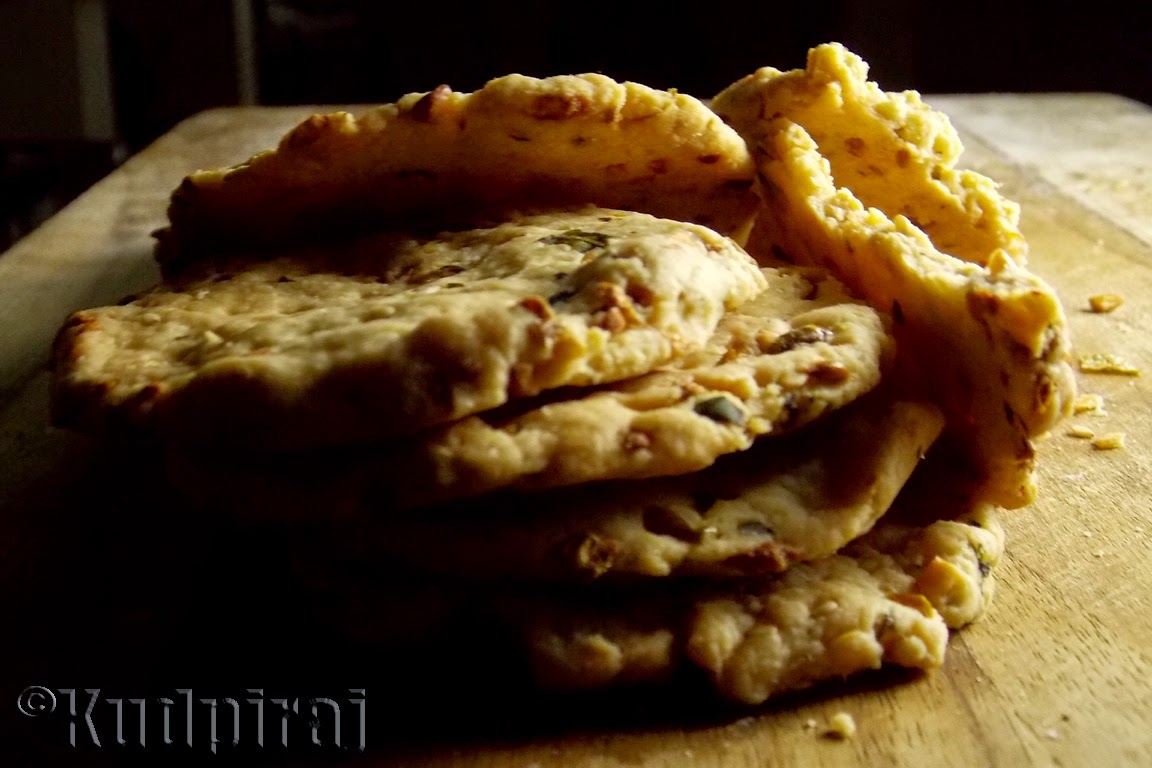
Baked Maddur Vada

Maddur is a small agricultural town in Mandya district of Karnataka state. It is identified by the lush green fields full of paddy and sugarcane, almost half way between Mysooru and Bengaluru. It rose to fame when Karnataka Scooters Ltd set up a scooter factory nearby in Somanahalli, to produce Falcon Scooters and Tyres way back in the late Seventies. This town is also world famous for the fried hot thin crispy vadas full of chopped onions and sesame seeds which are called 'Maddur Vadas'. As Bengaluru bound trains halt at Maddur, one can hear the vendors shouting Maddur Vada...bisi bisi gari gari Maddur vada..." which means hot n crispy Maddur Vada in Kannada. Couple of these lovely crispies with strong hot coffee make your journey all the more pleasant!
Reminiscing over the late Seventies when I just got my Bank job in Mysooru district, I used to travel often to Bengaluru by train. Then I used to peek to look out for those Maddur Vada vendors. Any fast trains with vestibule had many of those vendors running to and fro, doing brisk business. I used to whack two at a time and ask them to pack two more for rest of the journey!

Later, my cousin RD Pai took charge as branch manager of Syndicate Bank Somanahalli branch. I used to visit him on holidays or weekends and he took me to the Maddur Railway Station to the canteen, where they fried those vadas and served them fresh and hot, straight from the frying pan. They were the best Maddur vadas, and authentic ones. RD Pai used to emphasise that there were many people who made and sold
them on trains, but the ones made by the station canteen were original. I am sure, this fantastic snack was definitely formulated by expert cooks from Udupi side, as they only can make them perfect vadas and teach rest of the world how to make them!

Since then, I was trying to find them in many other places in Bengaluru. I did find some good ones made by a few restaurants such as CTR Shri Sagar in Malleshwaram but they tasted different than the original ones. The ever  popular Rava vada at Vidyarthi Bhavan Bengaloru is slightly different than Maddur Vada. Last year, Maiya's introduced many ready to eat packed traditional snacks among which, I found Baked Maddur Vadas and their cousin Baked Nippat. They were both perfectly made like almost all other snacks from Maiya's.

I was on the hunt for the authentic recipe to make them. After marrying and settling down in the late Eighties, Meena one day told me that a Shivalli Brahmin cook from a local restaurant in Mangaluru gave her some useful tips on making some snacks. He told her that to make Maddur Vadas we need Chiroti Rava, the finest variety of Bombay rava. I also remember her quoting that we need to apply salt, crush and squeeze the chopped onions along with chiroti rava so as to release the natural juices within the onion that is just sufficient to make a stiff dough adding hot oil and other ingredients. I am sure, she even had the recipe written down on a piece of paper and forgot to save it. We never made it till the other day when I decided to work on my own formula to make 'Baked Maddur Vadas', a healthy alternative for the demanding foodies who are health conscious.

Continuing the trend in making baked versions of traditional items, I searched the net for authentic recipe for Maddur Vadas but missed something or the other in each one of them. besides, baking them needs almost similar methods and ingredients as we follow for making cookies like Masala Biscuit. Adding milk products is essential, as we can't add eggs to them. So, my mind worked quick and I went back in time, recalling the flavour of original Maddur vadas tasted at the Maddur Railway Station.

Here's what I formulated and I am sure, all will try this and like it. Make them on cold winter days and serve them with some hot strong coffee, tea or hot chocolate. You can also serve these as cocktail starter snacks. They taste too good, very crisp and crunchy and they release an array of flavours as you relish them. Your family and guests will get amazed at your baking skills!

Ingredients:
Refined Flour(Maida) - 1 Cup
Rice Flour - 2/3 Cup
Chiroti Rava(Superfine Semolina) - 1/2 Cup
Baking Powder - 1 Tsp
Plain Butter - 60 Gm + 1 Tsp for greasing the baking tray
Salt - 1 Tsp(Approx)
Sugar(Optional) - 1 Tsp
Plain thick Yoghurt(Curd) - 1 Tbsp
Asafotoeda - A pinch(1 Gm)
Onions - 2 Medium finely chopped
Curry Leaves - 2 Sprigs finely chopped
Coriander Leaves - A handful finely chopped
Green Chillies - 4-5 finely chopped
Ginger - 1" piece finely chopped
Tiny Cashew Bits - 1 Tbsp
White Sesame Seeds - 1 Tbsp

Method:
Sift the flour with baking powder.
Mix in chiroti rava and rice flour.
Smoothen butter with a spoon, add to the flour mixture and rub with your fingers so that the mixture forms crumbs.
Dissolve asafotoeda and sugar in yoghurt.
Apply salt to chopped onions and keep aside.
Lightly pound the chopped ginger, green chillies and onions in a mortar, preferably traditional wooden one that we call 'Kolambi'.
Add pounded chopped onions, green chillies and ginger, chopped coriander leaves, curry leaves, cashew bits and sesame seeds to the buttered flour, pour the yoghurt mixture and knead lightly using your knuckles till the dough gets as soft as chapathi dough.
Make a single big ball of dough, cover and keep aside for 10-15 mins.
Keep the oven on at 180° C and preheat a lined baking tray or two for 10 Mins.
Grease a plantain leaf or a plastic sheet, aluminum foil or similar smooth and shiny surface to make vada pats.
Make 18-20 lemon sized balls from the dough, flatten them on the greased surface with your fingers into 4mm thick pats(discs).
You need not bother about whether or not you achieve perfect round shape.
Just make them evenly thick and prick them with a fork all over.
Grease the baking tray with butter, place the pats on the baking tray, set the oven at 180° C for 30 mins and start baking.
After 15 mins, flip the pats and bake on the other side.
In about 18-200 mins, both the sides must get evenly baked and the vadas must turn completely dry and golden in colour.
If still not crisp and dry, continue to bake at 100° C for further 10-15 mins.
Take out the baking tray and allow the vadas to cool down to room temperature on a wooden board on the wire rack.
Serve with choice of beverages but I always like a cup of hot strong coffee with them.
Remaining vadas can be stored in an air tight container and consumed over the next 2 weeks. 

LinkWithin

Related Posts Plugin for WordPress, Blogger...

Image Copy Control