Showing posts with label Festival Food. Show all posts

Friday, October 28, 2016

Karachi Halwa(Bombay Halwa)

Diwali, the most celebrated festival of lights is here again, and I have come out with Karachi Halwa(Bombay Halwa) in two flavours for our followers.
Strawberry flavoured chewy Karachi Halwa
When I talk about Karachi Halwa, my memory dates back to the mid Sixties, when my brother Shashikanth got his job in Bank Of India and settled in Bombay. Every year when he visited home town, he used to bring two types of halwas from Bombay, the popular Mahim Halwa or the Ice Halwa and the chewy sticky Karachi Halwa. Those days we called it Bombay Halwa. This halwa was formulated by the Sindhis from Karachi before Independence, when Karachi was part of India, and trade activities were brisk between Bombay and Karachi.

Karachi Halwa is a chewy Indian sweet meat made with arrowroot powder or corn starch, loaded with the goodness of almonds, pistachios and other dry fruits. In Mumbai it is available in different colours and flavours, sold in every nook and corner by mithaiwalas and this sweet has a prime place among Diwali Sweets. Typically they make this adding hydrogenated vegetable oil or vanaspati, but this tastes awesome when we make it with pure ghee. The chewy sticky halwa releases vivid flavours as we bite into the crunchy roasted nuts embedded within. Fine halwa comes in two textures, soft and sticky. Soft ones can not be preserved for more than 2 weeks and they also smell old sooner. Sticky ones can be preserved for over a month. The whole process requires nothing but patience, for you may need to keep stirring the contents for one to and one and half hours.

I am fond of this halwa which I wanted to make long ago, but somehow never tried until recently. First I tried this recipe from NDTV Food Channel by Chef Niru Gupta, but with my own variations. I also added strawberry crush which is readily available in 750ml bottle. That enhanced the taste of the halwa, making the eater crave for more and more!
Saffron flavoured soft Karachi Halwa
Second attempt was, making this with saffron flavour. This time I reduced the amount of added sugar and also set the halwa faster, which made it firm but soft. You can add amount of sugar in the proportion 1:1 but you can also increase the amount of sugar upto 1:2, that is for 1 cup arrowroot powder, you add 2 cups sugar. My preference is 1:1 for soft halwa and 1:1.5 for chewy one. Adding any fruit crush which has sugar in it, calls for reduction in amount of added sugar proportionately. In such case, my 1:1.5 formula works wonderfully well. Please also note that the total volume of added ghee should be not less than 100 ml for 1 cup of arrowroot powder and proportionate sugar. If you add more ghee, it floats over the top after setting the halwa, and can be used for making some other sweet dish or can also be used for pouring over Puran Polis. I didn't add cardamom to this halwa, as it spoils the flavour of strawberries as well as saffron.

Happy cooking, "Happy Festival of Lights to you all"!

Ingredients:
Sugar - 250-500 Gm(1-2 Cups depending on your requirement)  
Arrowroot Powder/Corn Flour - 1 Cup(115 Gm)
*Red/Orange/Green Food Coloring(As per the flavour you choose) - 3-5 Drops 
Strawberry/Orange/Pineapple/Lychee/Grape or any similar tangy fruit crush - 1/4 Cup(Optional)
Saffron - A generous pinch(Optional)
Lemon juice - 2Tsp or 1/2Tsp Ciric Acid dissolved in little water(I used lemon juice concentrate)
Ghee - 100 to 110 Ml
Almonds - 40 Gm 
Pistachios - 30 Gm 
Melon Seeds(Magaz) - 30 Gm
Water - 4-5 Cups 

Method:
Roast nuts and chop almonds and pistachios.

If you use saffron, soak it in little hot water and keep aside.
Dissolve sugar in 2 cups of water. 
Stir and boil for 5 minutes.
Mix arrowroot powder with sugar syrup.
Add 2-3 cups cold water to make a thin solution.
Strain through a sieve lined with muslin cloth.
Cook, stirring constantly with the wire whisker or wooden ladle, until the mixture thickens into a semi transparent gum.
Add lemon juice, food colour, optional fruit crush or saffron soaked in hot water.
Lemon juice/citric acid prevents sugar from crystalising. 
Keep stirring on medium heat, taking care not to char the contents.
When the mixture starts to stick to the base of the pan, add 1 tbsp ghee.
Keep stirring constantly with preferably a wooden ladle.
Now you can increase the heat to high.
Keep adding one tablespoon ghee every 3-5 minutes until the mass begins to foam, and forms sticky lump.
When stirring becomes difficult, the contents move with the ladle in one sticky mass and ghee oozes from the sides, switch off the flame.
Fold in the nuts. 
Pour into a greased tray. 
Smoothen with a greased spoon. 
Allow to cool completely.
This takes over 2-3 hours.
Cut into 1 inch squares and store in an airtight container.
Karachi Halwa with Lychee flavour
*As per flavours you choose, you can add these colours:
Strawberry/Raspberry/Cranberry - Red
Saffron - Orange Red
Pineapple - Yellow
Orange - Orange Red
Grape/Mixed Berry - Purple
Lychee flavour - No colouring
Plain(Without any added fruit pulp or flavouring) - Green 

Tuesday, September 13, 2016

Raagi Besan Laddu

"Onam Greetings to all those who celebrate the Festival"
Yesterday, I was planning to make some sweet for Onam. Meena had made Madgane/Chana Daal Payasam just 4 days ago, and I didn't want to make payasam again. As I was checking the ingredients for Besan Burfi or similar sweet in the fridge, I found a pack of raagi flour lying idle since months. Immediately I thought of Besan Laddu with added Raagi Flour.

Raagi or finger millet is a healthy cereal which is used much in Indian cuisine. It is also adapted in baking and making sweets. I am inspired by the Churmundo(Wheat Flour Laddus) that my mother used to make. She used to add little besan or chickpea flour while preparing the ingredients for that extra taste, flavour and stickiness. It is a fusion of Churmundo and Besan Laddu to be precise.

Having helped my mother in making churmundos during my younger days and also having seen how she made them those days, I have made these Raagi Besan Laddus, which are loaded with taste and flavour. One difference is, my mother didn't add raisins and nuts to churmundo, but I added, so that they taste more delicious. Though they look dark, the goodness of raagi will certainly make you turn a blind eye for the appearance and ecstatically indulge in relishing these pick me ups! I guarantee you, once you start tasting them, you will not stop at one! Kids may also keep sneaking into the pantry and ransack the jars to fish them!
Ingredients:
Raagi(Finger Millet) Flour - 1 cup
Besan(Chickpea Flour) - 1 Cup
Ghee - 2 Tbsp(30 Ml) + for greasing the hand
Cashewnut Bits - 30 Gm(Small 1/8 or 1/16 size)
Castor Sugar - 3/4 Cup(increase according to taste)
Green Cardamom - 4 Pods
Raisins - 30 Gm

Method:
Peel and crush cardamom seeds in a mortar with pestle.
Keep a wide shallow basin or platter ready for mixing the laddu ingredients.
Heat a thick bottom nonstick pan/skillet and dry roast the raagi flour on medium low flame until a nice aroma emanates.
Keep mixing with a strong wooden spatula, and take care not to char the flour.
This may take 5-8 minutes.
Remove and keep aside on a platter to cool down.
Add ghee to the skillet and fry the cashewnut bits until golden.
Drain and transfer on to the same platter containing roasted raagi flour.
In the same ghee, roast the besan until raw smell disappears and besan turns golden red, assuming a smooth pasty texture.
Transfer to the same platter.
Add castor sugar, raisins and crushed cardamom seeds, when the mixture is still hot, mix all the ingredients well with your hand.
Apply little ghee on your hand.
Take two teaspoonfuls of the mixture and shape it with your first three fingers by pressing and rolling into small lemon size laddus(balls).
Make 20-25 such laddus and allow to cool down completely.
Store in an airtight jar.
This recipe yields about 500Gms laddus.

Friday, December 25, 2015

Christmas Fruit Cake(Rich Plum Cake)

"Wish You All Merry Christmas and Happy New Year"
In the Sixties, I grew up in the cosmopolitan surrounding of Ballal Bagh Mangaluru, where we had friends from all communities meeting and playing together. However, at home, we had restrictions, were discouraged by our parents about walking into any Christian friend's home during Christmas, giving reasons that it is not good manners to attend Christmas parties uninvited. Yes. We never used to be invited by our Christian friends for Christmas because we were vegetarians and were living in a house owned by the Dharmasthala Heggades!

However I used to buy basic sponge cup cakes at a Christian's shop near our home whenever I felt like eating cake. That was made by Vas Bakery and was ultimate according to my experience. Later on, we moved to our own house and then slowly some Christian friends started to invite me for Christmas and offer cake, kuswar and juice. I used to wonder what that brown slice of cake was made of. It had French Polish like aroma and bits of dry fruits and nuts within. I was very fond of Christmas Fruit Cake, which they simply called as 'Christmas Cake'. That was light brown in colour and not very rich. Some of the best cakes were made by M D'Souza And Sons, Vas Bakery, City Bakery, Famous Bakery, Ganesh Bakery and Pinto Bakery.

In the Eighties, I moved to Bengaluru when I was working for a Bank. Then my brother Kamalakanth used to get Rich Plum Cake from Nilgiri's on Brigade Road. I too was regularly buying that whenever I went that side on weekends. Rich Plum Cake at Nilgiri's has loads of prunes, dry fruits and nuts within and is very moist and heavy. The name Rich Plum Cake suits Nilgiri's cake well. They still make awesome cakes, and Nilgiri's is undoubtedly my most favourite hangout for cakes and bakes. VB Bakery in South Bengaluru also has very good cakes and pastries.

Meanwhile in Mangaluru, as the city expanded geographically and people from all parts of India settled down for education and job, bakers came of age and started making exotic cakes. Moti Mahal and Manjarun started making birthday cakes and a variety of other cakes to order and also opened sales counters. We have seen many small and big bakers invading Mangaluru with exotic cakes. Hassan Iyengar Bakery opened on KS Rao Road sometime in the late Eighties and they had very good cakes. Focam Bakery and Bon Bon started supplying cakes to local Bakery outlets and their products are also good. Then we had Nilgiri's in Balmatta which closed down few years ago and now there is a big departmental store with bakery run by Mohtisham Group in Empire Mall under franchise from Nilgiri's. Crumbz by Food Pearls and Bon Bon's own outlet sell very good cakes. Every shopping mall has good bakeries within. Just Bake has outlets in prime locations and Cochin Bakery has many branches too. Monginis' Smokie and many more in the list. Dinoo's is one of the best bakers in Mangaluru making perfect cakes. Getting good cakes today in Mangaluru is not at all a problem when every major street has more than one good bakery!
Yet, making cakes at home has its own beauty. Taste of home made cake is anytime better because we add pure ingredients and avoid adding margarine. Margarine is bad for health, as it is made from refined vegetable oils with hydrogenation process. Using pure butter or ghee, we can make healthier and more aromatic cakes at home. Besides, when we share the cake with nears and dears, their happy faces and gratification speak volumes! Cake classes are run by youngsters and the middle aged, Shashi Shetty a veteran culinary expert used to run such classes in the Eighties in Kantharaj Shetty Lane Mannagudda, as far as I remember. Meena has attended baking classes by Mariam Mohiudeen and Meena bakes many cakes as a pastime. However, she hadn't ventured into making Christmas Fruit Cake or Rich Plum Cake any time. I decided to make it this time, as my zeal for baking is increasing day by day!

I must confess that am just a toddler in baking cakes, having baked very few cakes over the last month or two. I have an idea about rich plum cake, the ingredients and the method by reading recipes on books and magazines, but I wanted a demo of how to make it perfectly. So I browsed through online recipes, and found Joy Of Baking the best website with perfect recipes. Meena also follows Joy of Baking mostly and her cakes have been quite outstanding. The recipe I followed is this, but I made few changes here and there. Soaking dry fruits in alcohol for at least 2 days gives the cake a better taste and flavour than just pouring it into the cake batter. Adding spice powders like cinnamon, dry ginger and nutmeg enhance the flavour and give the cake a spicy touch. Adding fruit crush like the one I have added, enhances the taste and adds a fruity flavour. I avoided adding lemon zest and orange zest, but I added caramel, which is readily available. I also added dark brown sugar instead of light brown sugar. Thus the colour of the cake became as dark as the Rich Plum Cake made by Nilgiri's. Dry fruits used are mostly sourced from local stores like Nilgiri's and Phalguni's, but we procured almonds and walnuts freshly from Kashmir, through Kashmir Box. They have very good Kashmiri dry fruits and nuts at reasonable prices. I baked these cakes with double the quantity of ingredients mentioned and the total weight was over 4 Kilos.

Whenever he visits home from Barbados, my brother Radhakanth brings me 'Barbados Great Cake by A Mill Yard', one of the best in the world. It is made from finest Mount Gay Rum. To make cake as fine as that one, we need to spend a fortune over finest rum and soak raisins for at least one year in rum! I have never fancied spending huge money on alcohol for making cakes! I deem our local brand Khodays good enough for making rum based cakes. You can also use any other alcohol like brandy or sherry, but Khodays rum is inexpensive and has its own unique aroma good enough for making this awesome soft, moist, rich Christmas Fruit Cake.
Ingredients:
Unsalted Butter - 200 Gm
Dark brown sugar - 200 Gm
Eggs - 3
Alcohol (Grand Marnier, brandy, sherry, rum, etc.) - 90 Ml
Caramel(Or caramalise 2 Tbsp sugar with little water) - 1/4 Cup
Orange Juice - 1/2 Cup
Almonds, Walnuts, Cashew Nuts, Pecans, or Hazelnuts - 100 Gm coarsely chopped
Assortment of dried and candied fruit (Apricots, Figs, Prunes, Raisins, Sultanas, Dates, Black Currants, dried Cranberries, dried Cherries, mixed Candied peel and/or cherries) - 1 Kg deseeded and chopped into bite sized pieces
Mixed Berries Crush(Strawberries, Blue Berries, Black Berries) - 1/4 Cup
Refined Flour(Maida) - 2 Cups
Finely Ground Almonds(optional) - 3/4 Cup
Baking Powder - 1 Tsp
Salt - 1/2 Tsp
Grated Nutmeg - 1/4 Tsp
Cinnamon Powder - 1/2 Tsp
Dry Ginger Powder - 1/2 Tsp

Method: 
Be sure that you use all the ingredients at room temperature.
Mix in 45 Ml alcohol(I used rum) with the chopped dry fruits and candied peel in an air tight jar and allow to soak for at least 2 days at room temperature.
You may soak the fruits in alcohol for upto one year, but keep adding alcohol once in two weeks.
Preheat oven to 160° C.
Grease an 8" nonstick square or round baking pan. 
Line the bottom of the pan with parchment paper. 
Also preferably line the sides of the pan with a strip of parchment paper that extends about 2 inches (5 cm) above the rim of the pan.
Add 1/2 cup of the flour mixture and mix into the alcohol soaked dry fruits.
In a separate bowl, whisk together the flour, ground almonds, grated nutmeg, cinnamon powder, dry ginger powder, salt, and baking powder.
Beat the butter until creamy with a hand mixer in a wide bowl. 
Add the brown sugar, caramel and beat until light and fluffy. 
Add the eggs, one at a time, beating well after each addition. 
Scrape down the sides and bottom of your bowl as needed. 
Add another 30 Ml alcohol(I used rum), orange juice and blend well. 
Fold in the chopped nuts and berries crush.
Next fold in all the dried and candied fruits. 
Then fold in the flour mixture 1/2 cup at a time.
Scrape the batter into the prepared pan and, if desired, decorate the top of the cake with blanched almonds. 
Cover the pan with aluminum foil if you want the cake not to get too browned on top.
Place the pan inside the preheated oven and bake for 30 mins.
Remove the foil and continue to bake for another 30 mins.
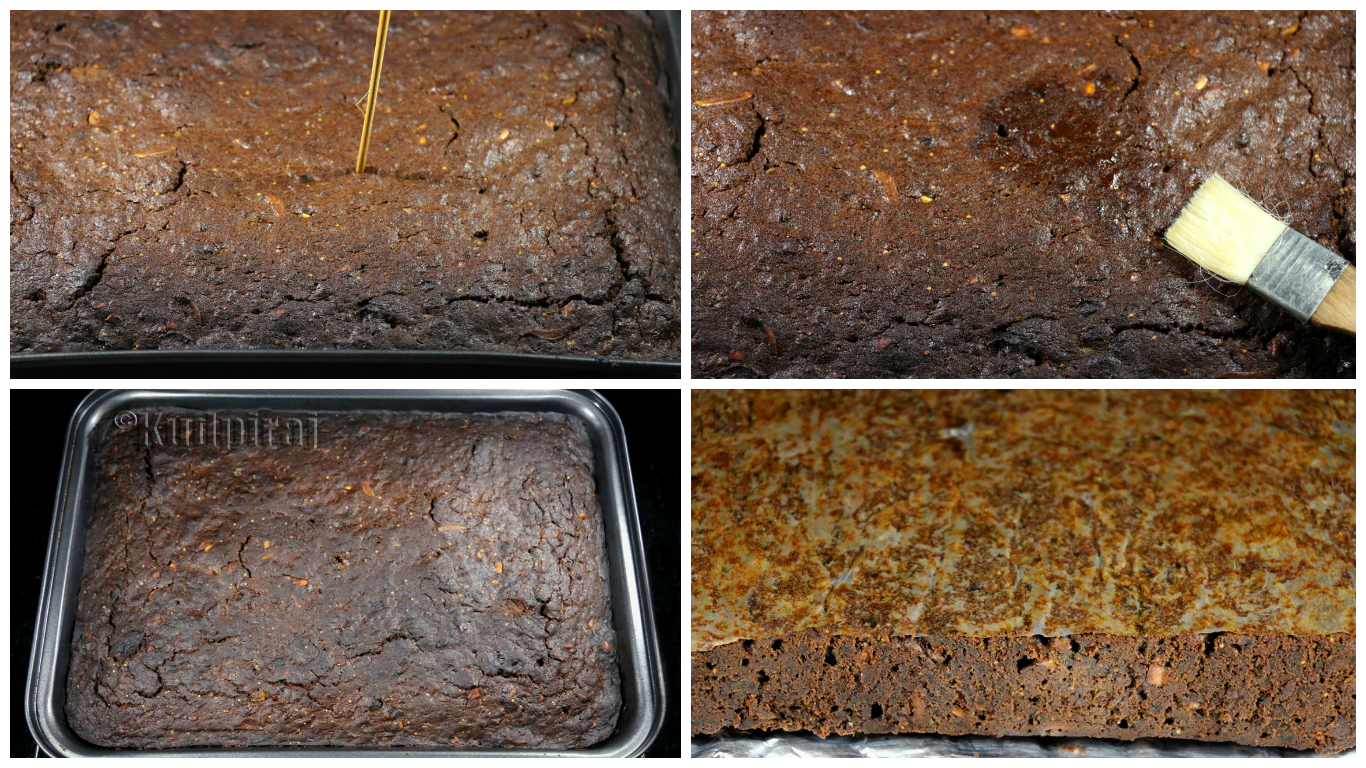
Insert a bamboo skewer into the center of the cake.
If it comes out clean with few moist crumbs sticking to it, your cake is ready.
If the cake is still wet, reduce the oven temperature to 150° C and continue to bake for further 20 minutes or until a skewer inserted into the center of the cake comes out with just a few moist crumbs. 
Remove the cake from the oven and place on a wire rack to cool completely. 
Then, with a skewer, poke holes in the top surface of the cake and brush with remaining alcohol (brandy, Grand Marnier, sherry, rum or whiskey).
Slice and serve with choice of juice or hot beverage.
Serves about 16 people.
Preserving the Cake: 
Wrap the cake thoroughly in plastic wrap and aluminum foil and place in a cake tin or plastic bag. 
Store in a cool dry place or store the cake in the refrigerator.
Brush the cake periodically (once or twice a week for about two to three weeks) with alcohol. 
This cake will keep several weeks or it can be frozen.

Thursday, September 17, 2015

Valval(Yogratna) - Mixed Vegetables Cooked in Coconut Milk

GSB cuisine has a sweetish bland delicious curry made with local mixed vegetables cooked in coconut milk. This resembles the Chinese dish Vegetable Chow Chow almost, but the flavours are different. A hint of green chillies for that subtle pungency within the smooth saucy coconut milk base, the medley of plant and root vegetables, the tempering with cumin seeds mustard seeds and curry leaves for that gentle touch of spice. These are the highlights of a simple GSB curry which has been deemed as one of the delicacies that is becoming a rarity among house holds, except at functions like weddings and festivals. 

Valval, otherwise known as Yogratna or Yogiratna is an exotic GSB curry. The name must have emerged from the appearance of the curry. It is rare, because we need to add fresh coconut milk to make it perfectly. Adding packed coconut milk/milk powder doesn't give the same feeling as fresh one! Caterers are cutting cost by adding less coconut milk and summing up for the sauce using the Chinese way of adding corn starch. 

I am a lover of this curry since my childhood days. Mother used to make it pretty well, and she insisted on getting fresh green coconut(Jeevo Naarlu/Hasi Tenginakaayi/Pajji Taaraayi) from Narayana Shetty's shop nearby, where we lived in Ballal Bagh. Now a days such coconut is a rare sight in Mangaluru simply because it is a fast perishable commodity. I can eat this curry as it is, just like we relish soups. It is very wholesome and nutricious.

We don't celebrate any festival at home with pooja or rituals. Yet, the reminiscence of my childhood days and the delicacies I had tasted at various festivals makes me go for some wonderful GSB goodies during the Gauri Ganesha Festivals every year. So I told Meena, "Lets make Valval for Gauri Ganesha this time. Haven't eaten good valval in recent times!". 

Ananda was there to pluck coconuts in the garden the other day, and I asked him to pluck one green coconut for us. Meena extracted thick and thin coconut milk and I made Valval for the first time in my life, that too without referring to any recipe on book or online. I have developed the ability to smell and taste a food, guess the ingredients that go into it. My father had that ability but he never cooked anything in his life, rather gave instructions to mother, and my sister Dr Veena Isloor also has that ability. She is a fine cook, and her Madras Sambar Masala is one of the best I have ever tasted!  
Well, vegetables were plenty at very reasonable prices at More outlet near our home. We GSBs make valval adding locally grown vegetables mostly, but these days people also add Carrots, French Beans, Butternut Squash, Chayote Squash and other imported vegetables. Essential vegetables to make this curry should not be pungent, not too tough and not sour or bitter. Some root vegetables and some marrow vegetables are added along with fibrous ones to balance the taste and consistency of the sauce. 

List of vegetables recommended:
1. Potato
2. Arvi(Colocasia Root)
3. Yellow Pumpkin(Dudhi)
4. Gerkins/Tuindora(Tendli)
5. Tender Cashewnuts(Bibbo)
6. String Beans(Alasande)
7. Elephant Yam(Suran)
8. Ash Gourd(Kunwale)
9. Chinese Yellow Cucumber(Magge)
10. Ridge Gourd(Ghosaalen)

Apart from these, you can add any similar veggies. The proportion of mixed vegetables and the coconut milk should be equal. That is, 400 Gms of vegetables should be cooked in 2 Cups or 400 Ml thick coconut milk. Also please remember that collective weight of each type of vegetable must be equal. Then the curry comes out well balanced. Seasoning with cumin seeds, mustard seeds and curry leaves is mandatory. Some add red chillies in seasoning, but that adds pungency to the gravy and I personally don't like it.

Extract thick and thin Coconut Milk following this recipe or use ready made packed coconut milk from store as per your convenience. Put in lots of love while cooking this, and thus Valval shall turn out very delicious, lip smacking good and fit for connoisseurs of fine dining.
Ingredients:
Mixed Vegetables(From the list mentioned above) - 400 Gms(or 4 cups)
Green chillies - 4, slit lengthwise
Coconut Thick Milk - 400ML(2 Cups)
Coconut Thin Milk - 400 Ml(2 Cups)
Water - 2 Cups
Rock Salt - 1 Tsp(or table salt 3/4 Tsp)
Ghee - 1 Tbsp
Mustard Seeds - 1 Tsp
Cumin Seeds - 1 Tsp
Curry Leaves - 2 Sprigs

Method:
Soak tender cashewnuts in hot water if dry and in cold water if fresh for 1-2 hours.
Peel and split the cashewnuts into halves.
Wash and peel root vegetables, leave the skin intact on other vegetables.
Chop arvi into thin discs, string beans into 1" lengthwise and other vegetables into 1/2" pieces.
Boil 2 cups of water in a 2 liter capacity pan.
Add tough veggies such as string beans, ash gourd, potato, arvi, tindora and tender cashewnuts first.
Cover and simmer for 5-10 minutes.
Pour thin coconut milk into the pan.
Now add the tender vegetables like green chillies, ridge gourd, yellow pumpkin and elephant yam and salt, cook for another 10 minues.
Once the veggies are properly cooked and a soup is formed, keep the flame at low and pour the thick coconut milk slowly.
Mix gently and allow to blend into the gravy gradually.
At this point the gravy should just bubble and should not seathe.
Excess heat will curdle the coconut cream and spoil the gravy.
Allow to cook for 3-5 minutes, check for salt and switch off the flame.
Heat ghee in a seasoning pan, add mustard seeds and cumin seeds, allow them to cracke, then add curry leaves and mix.
Pour the seasoning over the curry, mix well and close the lid.
Serve hot with rice and rasam, daalithove or as a delicious soup.
 

Wednesday, August 26, 2015

Simbly Superb Tulunadu Monsoon Food Festival by Simbly South

Tulunadu, the land of parboiled rice and coconut, the land of Kori Rotti and Sukkha, the land of Pulimunchi, Neeru Dosa, Khottige, Moode, Adai, Semiya, variety of chutneys,  pickles, curries and payasams has a range of traditional treats to offer during the monsoon months. Aati(Ashaad) month is specially marked for Tulunadu food festivals in nooks and corners of the undivided South Kanara district spreading from Trasi to Thokkottu and Udupi to Uppinangady, inhabited by various sects of Tulu speaking people settled around the lush green paddy fields greeted by the majestic tall coconut palms swaying to the rhythm of rain and South West Monsoon winds, welcoming travellers from other parts of the world to indulge in a feast offered by the various organisations, households and of course restaurants.

The Prestige Hotel in Balmatta Mangalore being pioneer in extending Tulunadu hospitality since the Nineties, has an exclusive restaurant serving local cuisine. 'Simbly South' is the name of the restaurant that is silently making waves with delectable hot and sour curries and other dishes at affordable prices. Though the restaurant serves many South Indian dishes, the zeal and determination of the management in bringing Tulunadu Monsoon food specialties to the connoisseur of fine dining made them arrange a 20 day long food festival which they aptly named as Tulunadu Monsoon Food festival. A simple decoration at the entrance reminding us of the Tuluva festivity, an arch made of bamboo dressed up in coir and 'Pingaara'(Areca flower) seems to stand tall and call the hungry passers by in Tulu "Balle Rayere, vanas aande? Banjara vanas maalpule!"(Come Sir, have you dined? Have sumptuous dinner) 


Yes. I was also one of those hungry people who was fascinated to see this unique arrangement. My friend Mahesh Nayak called me and asked me if I am interested in joining him for lunch on the last day of the Food festival on August 24, and the very mention of Tulunadu Monsoon Food festival made me jump for it! 

Having brought up in Ballal Bagh amidst Tuluva friends, where I have tasted many traditional delicacies since my younger days, having prepared many such delicacies at our own home for the last Three decades and also having hosted Michelin Starred Chef Vikas Khanna during the Mangalorean episode of Coastal Cuisine - Kori Rotti which was broadcast on Fox Life(Fox Traveller) in January last year, I had my taste buds craving for any Tulunadu special items that are offered during the monsoon season! Besides, since last two years I have been missing the food festival at Pilikula Guthu House named 'Aatidonji Dina', where I used to relish all the rainy day specialties.


We reached there at around 2:00pm and were greeted at the entrance with a 'Namaskar' and a broad smile by Nithin Shetty, the young and friendly Front Office Manager. I didn't fail to notice the attractive banner displaying typical Tuluva folk arts 'Yakshagana' and 'Bhoota Kola', the pictures showing few traditional delicacies, also a massive 'Poonja' or rooster that is usually employed in cock fight, gorging on paddy and ogling us with a curious look! 

As we entered the dining hall, first we heard Tulu Paddana(folk songs) like "O bele....." playing on audio, while Pili Vesha(Tiger Dance) was projected on LCD TV. I saw interesting counters on the right hand corner with Tulunadu artifacts from rural places, especially head gear made with locally available natural materials 'Muttaale', 'Pili Mande', Yakshagana Kireeta' and a big bonnet made with palm leaves used for protection from rains during cultivation in paddy fields. Other items on display included a Petromax lamp, Goli Soda bottles, Moode, Khotte, Betel leaves, Aracanut, Coconut, 'Vaale Bella'(Palm Jaggery), 'Gerase'(Dust Pan), 'Chenneda Gobbu'(A board game played with tiny shells), wooden 'Kalasa' for measuring rice, wooden plough, water lifting equipment and few other implements rarely seen in urban areas these days, since paddy fields are mostly converted into housing sites in Mangalore and the surrounds. Damodar Shetty, Director-Operations told us, that the guests can take their selfie pics while posing at the counter wearing any of the head gear and holding any of the props on display. Almost all the guests were seen taking their pics posing with those ethnic gadgets. I also didn't fail to notice crates full of Ginger Goli Soda in a corner which he said, are offered free to diners as digestive after having the sumptuous treat. Ginger soda is one beverage I had enjoyed drinking during my childhood days, which is not easily available these days in the market. I was thrilled to see goli soda bottle after a long long time!


The dining hall has cool a/c ambiance with pleasant lighting and decor. Plush seating and clean laminated tables laid with cozy dinner mats make the diners feel good. Damodar Shetty asked us what we would like to order. The menu had many items, each one more tempting than the other, but Mahesh said, we can have 'Agoli Manjanna Vanas', a special thaali which has over 25 items apart from welcome drink and digestive soda for just Rs. 275/- plus taxes. I checked the list of items that come with that package, agreed and said, "One thaali must be sufficient for the two of us! The list of items is too extensive, and I don't want to miss out anything!" While checking the contents of the thaali on our neighbouring table, the package seemed just right for moderate eaters like the two of us to share. So we ordered the Agoli Manjanna Vanas.

The waiters were looking homely in traditional Tulunadu attire like saffron 'Mundu'(Lungi), white shirt and a tricoloured shawl. They first served us chilled water in earthen 'Kooje'(flask) and then a glass of 'Panakam', a local drink concocted with jaggery and spices, which has a hint of black pepper in it, that energises the mood and also acts as appetiser.


Then they brought a hot soup made with tender bamboo shoot in terracotta bowls, which Damodar Shetty said is made with cooked rice broth(Ganji Theli) and added pepper and lemon. It was simbly delicious for words, and the floating bamboo shoot bits were very tender. Bowls filled with 'Ambade Uppaad'(Hog Plum Pickle), 'Timare Chutney'(Brahmi Chutney), 'Kudutha Chutney'(Horsegram Chutney) and 'Kukku Mudi Chutney'(Raw mango Chutney) were placed at our disposal, and the majestic Agoli Manjanna Vanas thaali made a grand entry along with a wicker basket containing 'Moode', Khottige', 'Pelatha Gatti'(Jackfruit Momo) and 'Manjalda Iretha Gatti'(Another kind of sweet Momo). Moode and Khottige are idlis steamed in Kaadu Kedige and Jackfruit Leaves, and the two sweet dumplings are steamed in banana leaf and turmeric leaf. Menthe Ganji(Fenugreek and Rice Porridge), a healthy dietary supplement was also one of the rare dishes presented.

The legendary 'Agoli Manjanna' popularly known as Bhima of Tulunadu was a macho man, who used to handle any manual task with ease. He also used to eat loads of food to tone up his body and muscles. Thus the name 'Agoli Manjanna Vanas'.


The thaali contained many bowls with a wide range of veg curries with sprouted grams, monsoon vegetables, bamboo shoot, pathrode, dry dishes, potato/rice happala, country chicken ghasi, sukkha, Mackerel fish pulimunchi, payasam and two other desserts 'Raagi Manni'(Finger Millet Pudding) and 'Bannangayi Pudding'(Tender Coconut Malai Pudding). Of course the Tulunadu staple steamed parboiled red rice 'Kajetha Nuppu' comes as accompaniment. As I gorged on each item, my memory drifted back into the past and made me reminisce over the good old childhood days when I had tasted most of those traditional delicacies. Each item was prepared carefully with right amount of pure ingredients picked by expert hands, with lots of love. I could feel that as I tasted each one of the dishes that had a special aroma and substance within. The bannangayi pudding was ultimate, and we went for a second serving, which Damodar Shetty kindly arranged for us. He also assured us that they make it quite often and it is also highlighted on their regular menu.


Praveen Shetty, Assistant Service Manager kept asking us if we are happy with the preparations. Damodar Shetty joined us in dining and he kept us good company while discussing about the various specialties Tuluvas make. When asked about future food festivals in lines of the one just getting over, he said, they toiled day and night to bring the best to demanding Mangaloreans and the tourists who responded overwhelmingly for the excellent arrangement, and it is not so easy to prepare so many traditional items freshly prepared twice a day, at one go for 20 days in line all the way! Not many hoteliers venture into such long food festivals he said, but the brains behind the concept namely himself, Nithin Shetty and Praveen Shetty put in their best efforts to make it a thumping success. The main problem he said, is collecting the right ingredients and getting the right formula to make it, for which some of the relatives and household ladies have helped. "We will continue serving the Mangaloreans, the forgotten delicacies of Namma Tulunadu", he said confidently. He also gave full credit to the chef who is expert in making South Indian dishes Simbly perfect, and we have reasons to agree with him. We had a taste of authentic Tulunadu Monsoon Food, which was a superhit at its first edition!


While leaving the restaurant, I didn't forget to click pics at the Tulunadu artifacts counter, along with those who attended to us with the best hospitality I ever experienced in recent times. I heartily thanked each one of them for taking me on a journey into the past and making my day!

Simbly South is arranging a one day 'Onam Sadhya' food festival to be held at the Shanthi Nilaya Hall opposite to The Prestige on August 28, 2015. A golden opportunity for Mangaloreans to relish many traditional Kerala dishes for reasonable price. Timings are between 12:30pm and 3:00pm. 
Onam Sadhya Food festival highlights

LinkWithin

Related Posts Plugin for WordPress, Blogger...

Image Copy Control