Showing posts with label Side Dishes. Show all posts

Sunday, July 24, 2016

Prawn Green Sukkha

Prawn Sukkha is a Tuluva dish, a cousin of Chicken Sukkha originated from Mangaluru and spread worldwide today. Any auspicious function in Tuluva household is incomplete without sukkha. I like Prawn Sukkha, we have been making the regular sukkha adding dried red chillies for too long, and I wanted to experiment with green masala. 

I replaced red chillies with green chillies and added chopped coriander and onion greens instead of cumin seeds while grinding the coconut for the final stage in making sukkha. That gave the brilliant green colour as well as good taste and flavour of fresh coriander leaves. Adding butter while cooking enhances the flavour of prawns, and coconut oil gives the authentic Mangalurian touch.

The dish turned out finger licking good and we ate this with Ghee rice for dinner.
Prawn Green Sukkha with Ghee Rice
Ingredients:
1. Jumbo Prawns - 500 Gms shelled and deveined(18-20 prawns)
2. Onion - 1 big, finely chopped
3. Garlic - 8+2 cloves
4. Green Chillies - 4 chopped
5. Coriander Seeds - 1.5 Tsp
6. Cumin Seeds - 1 Tsp
7. Fenugreek(Methi) Seeds - 1/4 Tsp
8. Black Peppercorn - 1/4 Tsp
9. Tamarind Pulp - A pea size pinch
10. Salt - 1/2 Tsp(Or to taste)
11. Turmeric Powder - 1/4 Tsp
12. Grated Coconut - 1/2 Cup
13. Coriander Leaves - 1/2 Cup Chopped
14. Onion Shoot(Optional) - 1 Sprig chopped
15. Curry Leaves - 1 Sprig
16. Coconut Oil - 4 Tsp
17. Butter - 2 Tsp

Method:
Wash and pat dry prawns.
Heat 1/2 Tsp oil and roast coriander seeds, cumin seeds, fenugreek seeds and peppercorn.
Grind together the roasted spices, chopped green chillies, 2 cloves garlic, 1/2 chopped onion and tamarind adding very little water, until smooth.
Remove the ground paste and in the same mixer jar coarsely grind grated coconut along with remaining garlic, coriander leaves and optional onion shoot.
Heat 2 Tsp oil in a saucepan and fry 1/2 chopped onion on high flame until transparent. 
Add prawns and turmeric powder and fry on high until prawns turn opaque.
Add the masala paste and fry for 2 minutes on high.
Add 1/4 cup water and butter, add salt, bring to a boil, cover and simmer for 5-7 minutes until prawns have just cooked.
Heat remaining oil in a frying pan.
Add curry leaves and fry until crisp, add  coarsely ground coconut garlic and greens paste.
Saute well for 1 minute on high flame and add this to the cooked prawn masala.
Check for salt and simmer for another 2-3 minutes, until the masala is thick and dry.
Serve hot as starter or side dish.
Prawn Green Sukkha with Sannas/Soft Idlis
Note: 
You can make Chicken Green Sukkha with 700 Gms Chicken pieces instead of prawns.
You can add 2 sprigs mint leaves while grinding the masala for that extra flavour.
You can also add 1/2 Tsp garam masala powder along with coconut in the end.

Friday, January 29, 2016

Green Papaya Pachodi Salad

Green Papaya or raw papaya(Popashphal in Konkani) is considered as a vegetable rather than a fruit, and is widely used in cooking. It is full of medicinal properties. Having high concentration of Papain, an enzyme that tenderises even the toughest meat, raw papaya paste is used as one of the ingredients for marinating mutton, mostly for making kebabs. We GSBs either prepare a stir fried curry adding garlic called talaasani or we add that along with Malabar spinach to make 'Vaali Popashphala Aambat.

However, when papaya plant becomes heavily loaded with raw papayas and suddenly starts leaning, we have to think about other alternatives. We got 4 medium size raw papayas from our friend Uma Shenoi's garden last week. I made some halwa, some cake and also some salad with them. I had seen recipes online to make 'Som Tam', a Thai salad, but one of the ingredients being fish sauce is a big no for me. So I decided to make salad with raw papaya somewhat like the Aambuli Pachodi or raw mango spicy salad found mostly during summer in Car Street Mangaluru.

This pachodi is a very simple salad made by mixing red chilli powder, salt, asafotoeda and coconut oil with chopped raw mango bits. It is relished as it is, with plain rice and curd, or with congi. The pachodi salad I made has a twist, adding capsicum, tomato and roasted peanuts, if not lemon squeeze. The masala powder I used to make this has many spices like red chillies, coriander seeds, cumin seeds, black peppercorns, mustard seeds, asafotoeda and turmeric powder. It is the same masala powder made for the exotic Aambuli Chutney)Spicy Raw Mango Chutney exclusively made in our family.

My idea was to blend our traditional masala with the similar ingredients that go into making the Thai salad while adding coconut oil for the authentic coastal Mangalorean touch. Added roasted peanuts appear occasionally and add to the crunchiness as you take bites. Raw papaya is tougher than cucumber or raw mango, and it needs either parboiling or should be lightly pounded in a mortar before mixing into the salad. Make this salad and instantly serve as a side dish with rice and daal, roti and curry or just savour with choice of fried fish or kebabs. It is tasty and full of flavours. Uma Shenoi gave a high five, and she ate it straight. She said, nothing can beat Mangalorean GSB style Som Tam from my kitchen!
Ingredients:
Raw Papaya - 300 Gms peeled and cut into julienne
Tomato - 1 medium cut into julienne
Capsicum - 1/2 medium cut into julienne
Roasted Peanuts - 2 Tbsp peeled and halved
Aambuli Chutney Masala - 2 Tsp
Salt - 1/3 Tsp(or to taste)
Sugar - 1/2 Tsp(Optional)
Coconut Oil - 2 Tsp
Lemon Squeeze - 1/2 lemon
Coriander Leaves - 1 Tbsp chopped

Method:
Soak the papaye julienne in ice cold water for 1 hour.
Drain and pound lightly in a mortar and keep aside.
Alternatively, blanch them for 10 mins in hot water, drain and keep aside.
Mix the papaya with other ingredients, check for salt and serve immediately.

Aambuli Chutney Masala Powder:

Aambuli Chutney Masala Powder is a versatile masala powder that can be used to make spicy chutney with raw mango, star fruit or bilimbi. It can also be used to make seafood preparations like fish tawa fried, chicken pulimunchi and Prawn Achari.

Ingredients: 
1. Red long chillies - 12
2. Red short chillies - 16
3. Coriander seeds - 3 tsp
4. Fenugreek seeds - 1 tsp
5. Cumin seeds  - 2 tsp
6. Black peppercorns - 1 tsp
7. Mustard seeds - 1 tsp
8. Asafotoeda - 5 gms
9. Turmeric powder - 1 tsp
10. Oil - 1 Tsp

Method:
Roast the ingredients 1 through 8 with little oil separately and keep aside to cool.
Powder in a blender along with turmeric powder.
Store in an airtight jar.
Note:
1. Do not chill this salad in a fridge because coconut oil tends to solidify and loses its flavour.
2. You can also make this salad by just adding red chilli powder if you can't make Aambuli Chutney Masala Powder.
3. You can also add 1 Tsp tamarind extract instead of lemon squeeze.

Friday, January 08, 2016

Egg Masala Fried

Egg Masala Fried is another exotic spicy coastal Mangalorean dish popularised by Thejappa Shetty's Shetty Lunch Home and Anupama Restaurant. This is traditionally called as 'Uppu Motte' by the Kundapur Bunts. Kundapur Masala Powder is used to make this quick side dish, which is not only easy to make, but is liked by almost all who taste it.
I used to be regular at Anupama Restaurant in Usha Hotel Mangaluru in the Eighties. We friends used to order this dish as starter to go with drinks. I had tried to ask Ravi Shetty, the partner of Anupama to spare the recipe but he showed his helplessness, saying that all the recipes were under their chef's hat and he wouldn't reveal any! I didn't press him further, for I knew that one day I will come out with the recipe for sure!

Then I tried making this at home with just garlic, chilli powder, tamarind extract and turmeric powder. It was very pungent and lacked flavour. I succeeded in making it better, after I formulated fish masala fried some years ago. The dish turned out a bit spicy, and I knew something else goes into it apart from red chilli based masala paste. 

Once I started making ghee roast, I could very well make out what was missing! The difference between ghee roast and masala fried is, that ghee roast has added ghee and brown onion paste, if not yogurt, but masala fried has just masala paste. However, unlike seafood masala fried, to make egg masala fried we need to add brown onion paste and yogurt for that sweet taste and sticky consistency. 

Then there was the magic masala, the Kundapur Masala Powder easily available at Sapna Stores Padubidri, and of late through our neighbours directly procured from Kundapur. Thus my job was easy. I have shared the recipe for making Kundapur masala Powder here. So what are you waiting for? Go ahead and make this lovely spicy tangy dish to pamper your family members!

Ingredients:
1. Eggs(Large) - 8
2. Coconut oil/Ghee - 4 tsp
3. Garlic flakes - 8-10 peeled and finely chopped(or 1 Tsp garlic paste)
4. Brown Onion Paste - 2 Tsp
5. Plain Yogurt - 2 Tsp
6. Tamarind pulp - A cherry sized ball of tamarind in 20Ml water
7. Kundapur Masala powder - 4 Teaspoons
8. Salt - 1/2 Tsp(or to taste)
9. Coriander leaves - A handful chopped
10. Lemon wedges - To serve

Method:
Hard boil eggs, peel and make gashes on them.
Mix Kundapur masala powder with tamarind pulp and little water if necessary to make a paste.
Heat oil in a shallow pan, fry the chopped garlic until golden. 
Add brown onion paste and fry until oil leaves the sides.
Add the masala paste, yogurt, salt and fry until oil leaves the sides. 
Place the boiled eggs, coat well with the roasted masala, sprinkle little water if the masala is too dry. 
After 2 minutes, switch off the flame, transfer into a serving bowl or platter, garnish with chopped coriander leaves and serve with lemon wedges.
Goes well with drinks as a starter, or as side dish with chapatis, plain rice or ghee rice.

Wednesday, December 16, 2015

Karela Chips(Bitter Gourd Chips)

There's a saying in Tulu, "Kanchala itthunda enchala unoli" which means if you have bitter gourd, you can dine well.

Yes. Haagalakaayi/Karaate/Kanchala/Karela or Bitter Gourd is an exotic oriental vegetable that adds taste to your dinner with its bitterness. Since you can't just eat bitter stuff as it is, you need to dress it up with some spices and taste makers. Best ingredients that neutralise the bitterness within this vegetable are salt, tamarind and jaggery. However, when you plan to make a deep fried fritter with this, you have to skip adding jaggery, but you can add little sugar. So just load it with salt and tamarind and don't worry about your health. Bitter gourd has goodness within its bitterness to sublimate any possible variations in your health.

These Karela Chips are popular in Mangaluru, especially at feasts following religious rites. Some of the rituals are not complete without Karela Chips. Now a days you get them readily packed at many local Bakeries. Caterers, especially Kusum Caterers in Mangaluru make them perfectly, and you may get them at their outlet in Lower Car Street, but home made ones always have a special taste and purity. You can make these when bitter gourd is cheap especially during monsoons and store them for days. They taste very good with rice congi or rice and curd. They turn out so crisp and crunchy, you may even like to relish them as its is!
Ingredients:
Karela(Bitter Gourd) - 250 Gms
Red Chilli Powder - 4 Tsp
Turmeric Powder(Optional) - 1/4 Tsp
Salt - 1 Tsp(Adjust according to taste)
Tamarind - Chickpea size ball soaked in little water(Or 1 Tsp pulp)
Asafotoeda - A generous pinch dissolved in little water(Or 1/2 Tsp powder)
Sugar - 1 Tsp
Rice Flour - 2 Tbsp
Corn Flour - 1 Tbsp
Oil - For deep frying + 1 Tsp

Method:
Wash and cut bitter gourd into very thin round slices.
Apply tamarind extract and salt.
Marinate the bitter gourd slices for 24 hours in the fridge.
Make a thick paste of idli batter consistency with chilli powder, turmeric powder, asafotoeda, sugar, 1 tsp oil, rice flour and corn flour, adding water little by little.
Apply this paste well over the bitter gourd slices and keep them marinated for further 30 mins.
Heat oil in a deep frying pan and maintain medium low temperature.
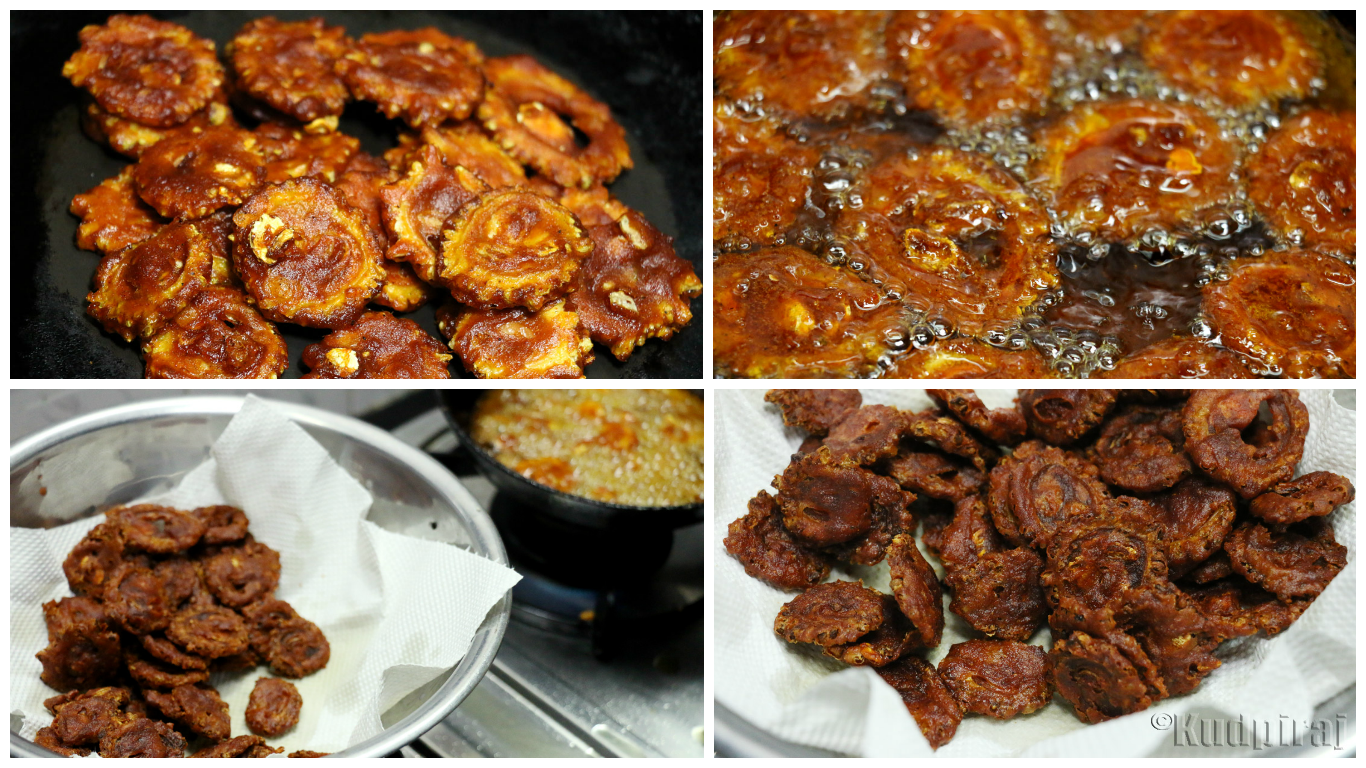
Drop the masala batter coated bitter gourd slices into the medium hot oil and fry for 3-5 minutes on both sides.
Drain and allow to cool down completely.
Fry as many batches as you can, but isolate them on a platter for easy identification and second frying.
Fry them a second time for 3-5 minutes or until crisp and brown.
Drain and transfer to a colander lines with absorbent paper.
Once cool, store in an airtight container and serve as and when you need them.
Best preserved in a fridge after 2 days.
Note:
The oil used for frying the chips can be saved and same oil can be used for frying kantola fritters or even for re frying karela chips when you want them crisp and hot.
Just take as many chips as you want from the fridge, heat oil and fry them for 2 minutes on medium low heat.

Friday, November 06, 2015

Squid/Kalamari/Bondaas Butter Garlic(Chinese)

Kalamari or Squid in India used to be a seafood item, mostly thrown as manure in estates and gardens until the late Eighties, when Chinese restaurants started making delicacies with it. At least in Mangaluru cuiity, I have never come across squid preparations at local restaurants until 1989. We friends used to go for fishing at the breakwaters near New Mangalore Port in the mid Eighties, when the fishing boat guys used to give us squid and some small fish free which we used as bait to catch fish. Locally they call it 'Bondaas'.

After 1989, I came across Bondaas Chilli and Manchurian at local restaurants, but I didn't like it much because it tasted rubbery and insipid. Then in 1991, as I was sitting at the counter of Knight Rider Pub talking to Alan the manager cum kitchen in charge about innovative snacks that he can introduce in the pub, Alan asked me if I'd like to taste Bondaas. I thought he was talking about Bonda, the deep fried snack like batata vada, and asked him if he makes vegetable bondas or potato bondas! He smiled aloud and said, he meant Squid! I ordered one plate of Bondaas Chilli and he prepared it himself, it turned out fantatic, and I fell for it immediately!

Then I started tasting squid at various restaurants, Chinese as well as local ones making Bondaas Sukkha, Masala Fried and Ghee Roast. Squid became a favourite with myself, as well as Meena. yet, we were choosy about the way they cooked, because over cooking or under cooking spoils the taste and texture of squid. Also, over grown squid needs some pressure cookign before using in dishes due to the thick coconut kernel like consistency. I think the name Bondaas was derived from Bonda(tender Coconut), because tender coconut malai or kernel resembles squid to a great extent.

Squid butter garlic is one Chinese dish that is very delicious and has lovely aroma that makes you eat more and more. It is rather bland, but you can make it spicy by adding some green chillies and an extra dash of pepper while making it. Most of the restaurants cut squid into rings but I like them in rectangular strips, scored on one side, which when fried, curl up and form a nice checkered pattern. Scoring also helps in marinating them properly. 

Scoring means making fine streaks or gashes on the inside portion of squid in a crisscross pattern. You can design checks or diamonds as you wish. It takes very little knack to score them properly, if you have a sharp knife, as shown in the pictures. if you are not confident or patient enough, just slice them into 1/4 inch thick rings.

Make this lovely dish and serve it as a starter, or as side dish with noodles or fried rice. I am sure, everyone at home will like this. Kids will jump with joy, for there are no spicy sauces, no extra pungent agents to cause heartburn or acidity. Most of the ingredients in this are natural, pure and healthy.
Ingredients:
Squid(Kalamari/Bondaas) - 500 Gms
Garlic Cloves - 8-10 chopped
Green Chillies(Optional) - 2 finely Chopped
Spring onion bulbs - 4-6 chopped
Salt - 1/2 Tsp or to taste
White Pepper Powder - 2 Tsp(Add little more if you are not adding green chilli)
Sugar - 1/2 Tsp
Corn Flour - 2 Tbsp
Refined Flour - 1 Tbsp
Chicken/Vegetable Stock - 250 Ml(1 Maggi cube boiled in 250 ml water for 2-3 minutes)
Dark Soy Sauce - 1 Tsp
Diluted White Vinegar - 2 Tsp(Add 1/2 Tsp vinegar to sauce if you are not using lemon juice)
Lemon Juice(Optional) - 1 Tsp
Refined Oil - 2 Tsp + for deep frying
Butter - 2 Tbsp
Spring Onion Shoot - 2 Sprigs chopped

Method:
Clean wash and pat dry the squid.
With a very sharp knife, cut them open and make crisscross scores(Parallel gashes) only on the inside surface, taking care not to cut through them.
After you complete scoring, cut them into 2" long and 1 " wide rectangular strips.
Marinate the squid pieces with salt, 1 Tsp white pepper powder and vinegar for 1 hour.
Mix in 1 tbsp corn flour and 1 tbsp refined flour to coat the squid pieces.
Heat sufficient oil in a deep frying pan until it starts fuming and then maintain medium or small flame.
Fry as many squid pieces as the oil can hold at a time, for 3-5 minutes or until they turn crisp and golden.
Drain and keep them in the serving bowl.
Heat 2 Tsp oil in a shallow pan.
Mix remaining 1 Tbsp corn flour in little water to make a thin paste.
Stir fry chopped green chillies along with chopped garlic and spring onion bulb on high flame.
Add a pinch of salt, 1 tsp white pepper, sugar, soy sauce, then pour in the stock.
Bring to a boil and simmer for 2 minutes.
Mix in the corn starch paste and allow the sauce to get thick and transparent.
Now add lemon juice(or vinegar), butter and if necessary little water, allow to sizzle for 1 minute.
The sauce should be as thick as sweet corn soup.
To serve with fried rice or noodles, pour the sauce over the fried squid.
To serve as a starter dish, drop the fried squid into the prepared sauce and allow the sauce to coat the pieces and make them semi dry. 
Garnish with chopped spring onion shoot and serve hot.

Wednesday, October 21, 2015

Bhindi Pakora/Croquette

The year was 1989, I was at Temple Square Mangaluru, celebrating the annual Okuli following the Car Festival, rejoicing with few friends. My Bank mate and cousin Kudpi Ganesh Shenoy offered me some fried snack which he got from a nearby stall. They looked like nuggets but he said it is 'Bhindi Bajia/Bhenda Bajo/Pakora', a kind of fritters made with chopped Okra and gram flour. I popped couple of them into my mouth and started chewing. I went on chewing them for about 5 minutes, but could not gulp them! I also felt terribly thirsty, and I ran to nearby Soda shop and guzzled down a cold soda to push the stuff down my throat. Then I told my cousin, "I can not forget your favour man! Henceforth I should avoid eating Bhindi Bajia!" He smiled and said they are made like that, with overgrown bhindi. I was shocked to know that, for it was the first time I tasted them in my life, and they were tough and fibrous!

Later, I started visiting Balli's Podi shop where I found better Bhindi Pakoras made with tender okras. I also found very good pakoras at Kusum Caterers' Podi joint in Lower Car Street. I developed a liking for them, and started buying them whenever I visited car Street.

I have been thinking about making Bhindi Pakoras at home the way they make it in car Street, but somehow that plan didn't materialise. The other day Meena had made Bhindi Upkari for dinner, and I asked her if we have some left over bhindi. She said yes, but she had a doubt whether they suffice my requirement in making pakoras. I too found the quantity of bhindi insufficient. Then an idea struck me, and I took out the Bok Choy or Chinese Cabbage and a piece of carrot resting in the fridge. I also took last remaining sprigs of the onion shoot left over from making noodles and Butter Garlic Squid last week. Adding them all together, mixing in some masalas, chillies and coriander leaves, I mixed in gram flour and rice flour to make a stiff dough, which I shaped like croquettes instead of nuggets and deep fried to get an awesome starter snack. 

Here is that fantastic snack which tastes almost like seekh kebabs and has lots of flavours. They turn out soft inside and crisp outside, easy to bite into. Not at all chewy like the ones I had on that Okuli day in 1989, I guarantee you! You can serve them with sweet mint chutney or with ketchup if you are having them with cocktails, mocktails, or as a tea time snack. They also taste good when served as a side dish with rice and daalithove. 
Ingredients:
Tender Okra(Bhindi) - 1 cup finely chopped
Bok Choy/Cauliflower/Cabbage/Palak leaf - 1 Cup finely chopped
Coriander leaves - 1/2 Cup, finely chopped
Spring Onion Greens(Optional) - 1/4 Cup, finely chopped
Carrot - Grated or finely chopped, a handful
Green Chillies - 3 finely chopped
Ginger - 1/2 Inch finely minced(or ginger paste 1/2 Tsp)
Salt - 1/2 Tsp(or to taste)
Gram Flour(Besan) - 1/2 Cup
Rice Flour - 2 Tbsp
Red Hot Chilli Powder - 1/2 Tsp
Turmeric Powder - 1/8 Tsp
Coriander Powder - 2 Tsp
Cumin Powder - 1/2 Tsp
Chaat Masala - 1 Tsp
Oil - For deep frying

Method:
Heat oil in a deep frying pan until it starts to fume.
Simmer and keep the flame on.
Keep a bowl of water ready.
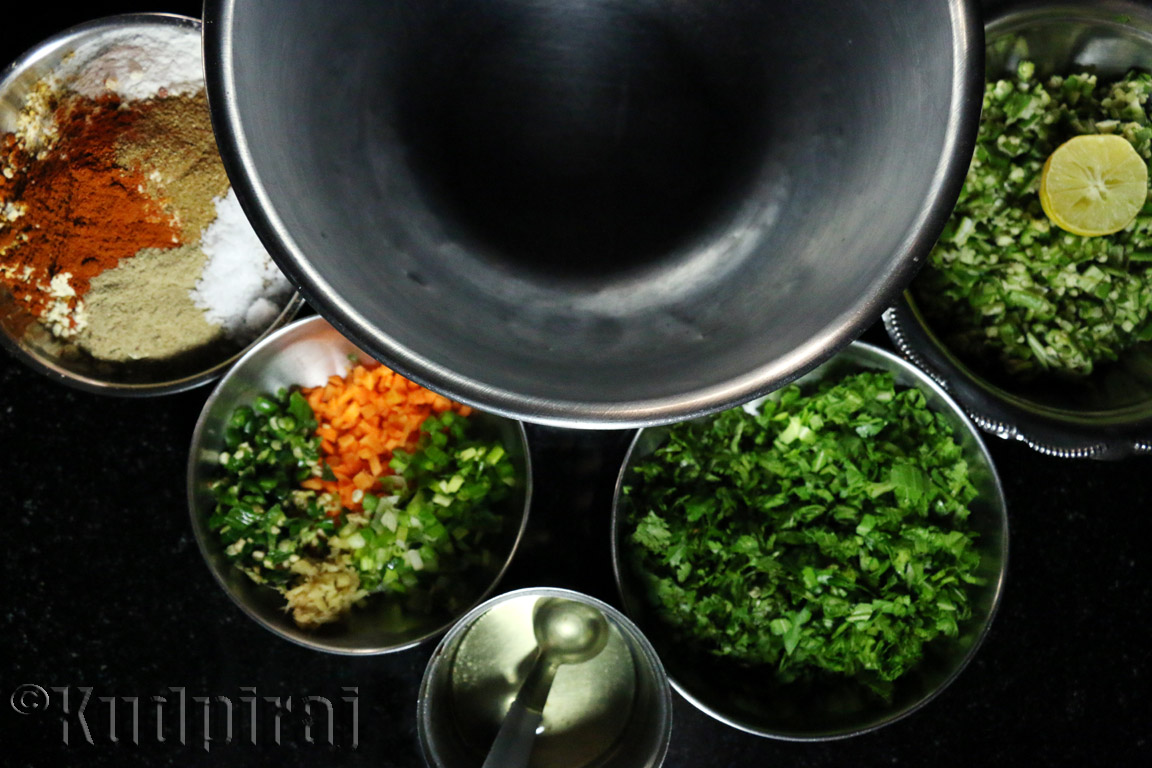
Take all the chopped veggies in a mixing bowl.
Add the powders and a tablespoon of hot oil.
Mix well, sprinkle two to three tablespoon of water and make a stiff but sticky dough.
Dip your fingers in the bowl of water, take lemon size dough and make a ball.
Shape the ball into a 2" long croquette.
Make 16-18 such croquettes and deep fry 4-5 at a time in hot oil on low flame for 5 minutes or until they turn golden brown and crisp on all sides.
Drain on kitchen paper and serve. 

LinkWithin

Related Posts Plugin for WordPress, Blogger...

Image Copy Control