Rasam Vada is a combo snack served in Udupi style restaurants. Though Chennai is famous for this snack, it was popularised by the Madhwa Brahmins from Udupi. Crisp and hot Medhu Vada is topped with piping hot sweet hot and tangy Udupi style Rasam. Tastes heavenly on a rainy day! I first tasted this combo snack in the Eighties at Mohini Vilas, a traditional Udupi style restaurant in Mangaluru where they also served Ghasi vada and Mor Kolumbu Vada alternatively. Janatha Deluxe serves nice rasam vadas these days in mangaluru. They make them pretty well, but I didn't know the perfect recipe for authentic Udupi Rasam until two weeks ago. Once I found the recipe for Udupi Rasam, I was surprised to see Meena preparing medhu vadas for breakfast the same day! I immediately grabbed few vadas and made Rasam Vada. My niece from USA Deepa visited us that evening with her mother and daughter. They all liked the rasam vada very much. All you need is Medhu Vadas following this 'Biscuit Ambade' recipe, but to make medhu vadas you need some practice. You need to dip your hand in water, make a lemon size ball with biscuit ambade batter and with your thumb and index finger, press the batter to make a hole in the center. Immediately drop this in hot oil and fry until crisp. Make Udupi Rasam, arrange vadas in soup bowls, pour 1/2 cup rasam over each vada and garnish with freshly chopped coriander leaves and serve hot.
It was year 1980 and the month was December. In the biting winter cold, I was walking towards Shanker’s Book Library in Basavangudi Gandhi Bazaar area along with my cousin Premakar Shenoy, who was going to introduce me to Shanker, the owner of the library. Shanker ran his library in the garage of a home near Basavangudi Police Station, and he had many books and magazines of interest to me, especially Asterix comics and Mad magazine and books. Premakar also introduced me to a traditional Udupi restaurant perched in a small old house on Gandhi Bazaar Main Road named Vidyarthi Bhavan. He said, the Perfect Masala Dosa takes birth there, and conquers the gastronomy of those who wait in line outside to get into the restaurant on a busy evening, such as the one that day.
I was peeking through the iron rods embedded in the closed painted wooden doors and windows and drooling over the divine smell of melting butter mixed with onion potato curry stuffing as people gorged on the crisp and hot masala dosas dipping them in a pool of spicy chutney. I had also determined to go for two of them, even before I had tasted them for the first time! Finally the doors opened and we were allowed to enter. All those who were waiting with us ran quickly and occupied available seats in the lengthy dining hall that resembled the chair car of Indian Railways. Premakar said “Let’s go inside and sit on the bench outside the kitchen. That’s the only place where we can get a chance to sit and eat, unless you prefer to stand and eat!” So we went inside and sat on a wooden bench next to a grinder in which chutney was being ground nonstop. As one batch of chutney was ready, a kitchen helper came out and collected it in steel buckets and poured soaked gram daal, green chillies, herbs and spices into the grinder to make more chutney. I could also make out most of the ingredients but not the proportion. Each batch of chutney tasted the same because they added right amount of green chillies, mint leaves, coriander leaves and salt, if not some secret spice! Then they served us dosas without even us ordering them! It was understood that those who came there mostly came for eating masala dosa and very few who could not resist drooling over their neighbours hogging on hot dosas ordered a rava vada, medu vada or a khaara bhaat. That’s the usual scene in the evenings even today at Vidyarthi Bhavan, haven for the ‘Perfect Masala Dosa’. I became a fan of Vidyarthi Bhavan instantly, and needless to mention here, that my first and the subsequent visits were incomplete without gobbling up two of those lovely masala dosas at a go! Sometimes my cousin Premakar would get dosas home packed in banana leaf, when I or my brother Dr Radhakanth Shenoy visited his home. Those of course never remained as crispy as we get them served hot at the restaurant. Now why is it called as ‘The Perfect Masala Dosa’? Masala Dosa at Vidyarthi Bhavan is a big half moon shaped dosa which is thick, crispy dark red outside and soft and spongy white inside. It is stuffed with a simple but tasty potato onion bhaaji(dry curry) and fresh melting butter oozes out as we break the dosa, scoop a little potato curry and dip it in a pool of chutney. As we relish the dosa, an array of flavours dance on our tongue and invigorate the senses, if not elevate the mood! The crunchy sound of dosa being masticated between the jaws releases juices in the mouth of the watchers by, making their hunger multiply and decide to go for at least two dosas at a time! Thus I think, the title ‘Perfect Masala Dosa’ suits the dosa at Vidyarthi Bhavan, which has been a phenomenal restaurant, rather a heritage restaurant for the connoisseur of fine dining over the last 7 decades! Bengaluru without Vidyarthi Bhavan could be somewhat like Bengaluru without Lal Bagh! There may be hundreds of restaurants serving masala dosas in Bengaluru, but Vidyarthi Bhavan has been an iconic restaurant not only in my heart, but also for at least a hundred thousand other people settled all over the world!
As per information available on official website of Vidyarthi Bhavan, this hotel was started by Venkataramana Ural from Saligrama near Udupi in the year 1943, in a small house in Gandhi Bazaar. It first used to cater to students (Vidyarthis) but later it was let open to public. His brother Parameshwar Ural then took it over and ran the business. No wonder noted Kannada scholar and Yakshagana exponent Dr Shivarama Karanth’s birth place has also given birth to able people, who have perfected the art of making masala dosa! Later in 1970, Ramakrishna Adiga hailing from Shankarnarayana near Kundapur took over and started managing the restaurant. What changed was just the management, but the name, tradition and recipes remained the same, so was the service standards of many of the employees. The overflowing demand and its profound popularity should be the prudent evidence for its unchanging taste, flavour & delicacy. Vidyarthi Bhavan has seen noted scholars, actors, artists, politicians and philanthropists frequenting there for the Perfect Masala Dosa. Few years ago the restaurant was refurbished and dining area can now accommodate more people, at the same time old grandeur has been maintained with Coastal Karnataka style high terracotta tiled roof with natural light and air allowed through proper ventilation. A waiter named SV Murthy has drawn sketches of scholars and scribes during his pastime, which are framed and displayed on the walls from end to end. Arun Kumar Adiga, a young Engineer who quit his technical job and joined his father in running the show, manages almost everything about Vidyarthi Bhavan today. I met him online while browsing through Facebook one day when I saw my brother Dr Radhakanth Shenoy, another fan of Vidyarthi Bhavan liking a post on Vidyarthi Bhavan’s page. I posted the link to the video I had made two years ago about Vidyarthi Bhavan which I had uploaded on youtube, and Arun immediately recognized my work and communicated with me via message, inviting me to Vidyarthi Bhavan during my next visit to Bengaluru! I accepted his invitation and visited there recently, but I also made it a point to take my cousin Premakar along with, who had introduced me to Vidyarthi Bhavan way back in 1980 December.
My nephew Darshan Pai took us to Vidyarthi Bhavan in the morning
at around 10:45am. It was as crowded as always, and I sent my business card
through the gentleman at the main door controlling the crowd. Arun Kumar Adiga
appeared after 10 minutes, and after formal introductions and exchange of
greetings, I went around with my camera clicking the photos of people gorging
on masala dosa and other delicacies. Arun permitted me to enter the kitchen
which is now in a different location within the premises and I had a chance to
see how 25-30 masala dosas are made at a time by two experienced cooks and how
expert waiters stack plates with 14-20 masala dosas balanced in one hand at a
time and serve them without any effort! That phenomenon has been in vogue even
when I first saw those serving dosas in 1980. Nothing has changed much as far
as quality control and cleanliness are concerned. The old mosaic flooring, the
wooden tables and seats, the plates and tumblers are all maintained clean and
shining. Clean filtered cooled water is served and billing is done by machine.
Arun led us to the corner table and ordered masala dosas and coffee for us. Premakar said he will take a dosa packed for consumption at home and was happy with a cup of strong filter coffee. Premakar also insisted that he will pay for the packed dosa for old time’s sake. Arun could not stop him from paying for that dosa anyway! Arun spoke at length about how they manage the show in this millennium when availability of labour is scarce. He explained how they refurbished the house without demolishing any permanent structure and that too retaining the old grandeur! He also mentioned about the heritage walkers of Bengaluru who periodically take a long walk visiting various restaurants and tasting one item at each place, he proudly expressed his feelings about the accolades and awards won by Vidyarthi Bhavan for maintaining standards and also about their place of family origin Shankarnarayana near Kundapur.
"It gives us immense pleasure and makes us feel good, when someone from a far away place or abroad visits us, relishes the dosa and reminisces over the past! Many bloggers and media people come here and cover the place for articles. We get motivated by them and carry forward the 70 year old trend set by the founders of Vidyarthi Bhavan." Arun sounded candid and contented.
Premakar had some fond memories to share with us, especially about the day in summer of 1961, when he visited the restaurant with his father as they were coming back with the prospectus for his admission into BMS College of Engineering in Basavangudi. He said “Well, that day as my pop told me he will take me to Vidyarthi Bhavan and buy me a masala dosa which is a specialty there, I told him, look! Vidyarthi Bhavan is for students, and they may not allow you in! Contrary to my apprehension, my pop was not only allowed inside but he also relished the dosa with me that day! Then I started frequenting here and have been a regular here since last 5 decades"
After clicking a few photos with our host Arun Kumar Adiga, we also met Ramakrishna Adiga, Arun’s father who mostly manages the cash counter. He is a silent and friendly person with a broad smile. He was impressed to know that I had covered Vidyarthi Bhavan for a youtube video documentary titled ‘Bombaat Bengaluru - Part1’, two years ago. With the taste of the Perfect Masala Dosa and strong filter coffee lingering on our taste buds, we left Gandhi Bazaar and reached home.
As Premakar opened the parcel, we were in for a big surprise! The Masala Dosa was a tubular one as against the half moon shaped dosa we ate at Vidyarthi Bhavan and it was neatly packed in a carton lined with waterproof material. Chutney was sealed in a disposable plastic tub, which ensured zero spillage! Not a single drop of oil had dripped in the box, nor did the dosa lose the crispness, which signifies the quality of packaging. I said hats off to Arun Kumar Adiga in particular, and Vidyarthi Bhavan in general, for the innovation!
There ended revisit to my favourite hangout for the Perfect Masala Dosa, this time with more meaningful time spent with Arun Kumar Adiga who made us feel good. Needless to mention, that leap of The Perfect Masala Dosa from the kitchen of Vidyarthi Bhavan to the dining table of Premakar’s home was pretty neat! With inputs from: Vidyarthi Bhavan official website.
Address: No-32, Gandhi Bazar Main Road, Basavanagudi,
Bengaluru - 560 004 INDIA Email:contact@vidyarthibhavan.in Phone:+91
80266
77588
Timings:
Monday-Thursday: 6.30AM to 11.30AM - 2.00PM to 8.00PM
Saturday,Sunday & Public Holidays: 6.30AM to 12.00PM - 2.30PM to 8.00PM
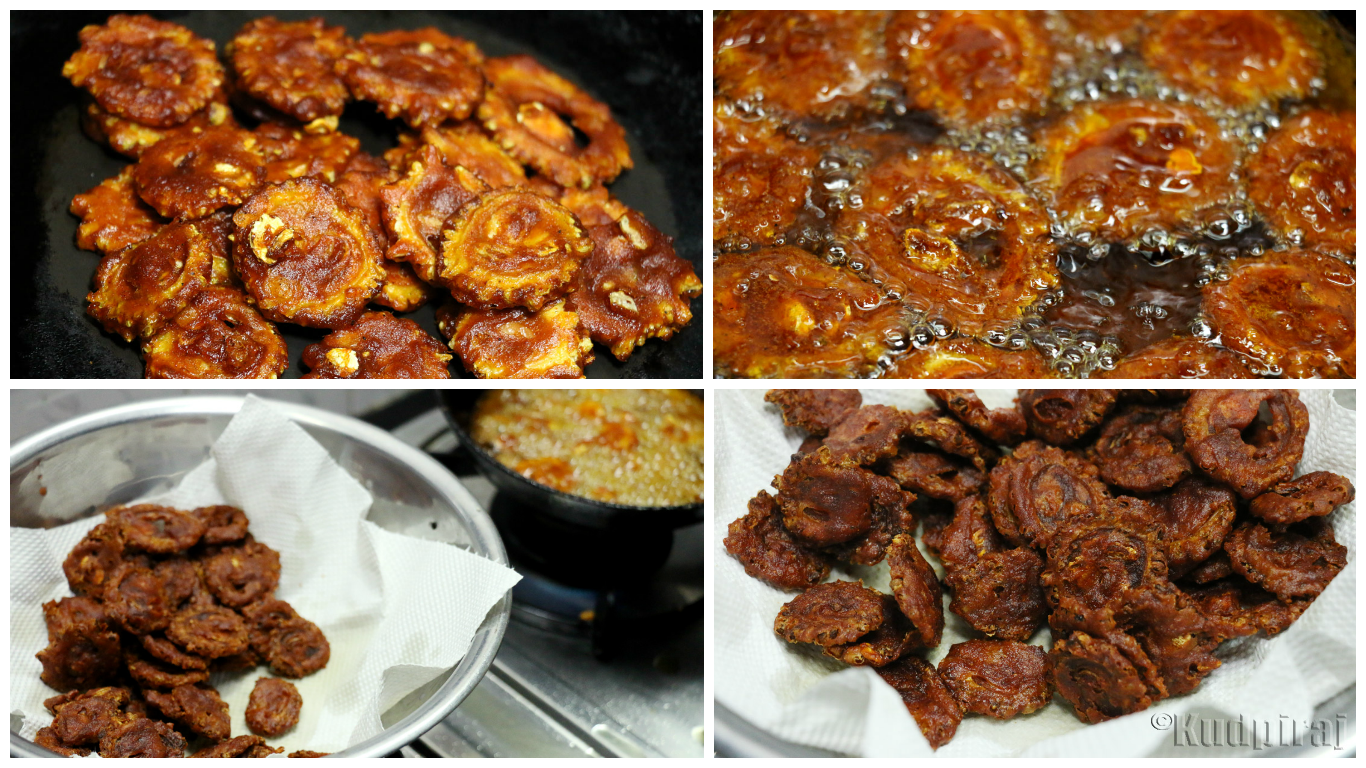
There's a saying in Tulu, "Kanchala itthunda enchala unoli" which means if you have bitter gourd, you can dine well. Yes. Haagalakaayi/Karaate/Kanchala/Karela or Bitter Gourd is an exotic oriental vegetable that adds taste to your dinner with its bitterness. Since you can't just eat bitter stuff as it is, you need to dress it up with some spices and taste makers. Best ingredients that neutralise the bitterness within this vegetable are salt, tamarind and jaggery. However, when you plan to make a deep fried fritter with this, you have to skip adding jaggery, but you can add little sugar. So just load it with salt and tamarind and don't worry about your health. Bitter gourd has goodness within its bitterness to sublimate any possible variations in your health. These Karela Chips are popular in Mangaluru, especially at feasts following religious rites. Some of the rituals are not complete without Karela Chips. Now a days you get them readily packed at many local Bakeries. Caterers, especially Kusum Caterers in Mangaluru make them perfectly, and you may get them at their outlet in Lower Car Street, but home made ones always have a special taste and purity. You can make these when bitter gourd is cheap especially during monsoons and store them for days. They taste very good with rice congi or rice and curd. They turn out so crisp and crunchy, you may even like to relish them as its is!
Ingredients: Karela(Bitter Gourd) - 250 Gms Red Chilli Powder - 4 Tsp Turmeric Powder(Optional) - 1/4 Tsp Salt - 1 Tsp(Adjust according to taste) Tamarind - Chickpea size ball soaked in little water(Or 1 Tsp pulp) Asafotoeda - A generous pinch dissolved in little water(Or 1/2 Tsp powder) Sugar - 1 Tsp Rice Flour - 2 Tbsp Corn Flour - 1 Tbsp Oil - For deep frying + 1 Tsp Method: Wash and cut bitter gourd into very thin round slices. Apply tamarind extract and salt. Marinate the bitter gourd slices for 24 hours in the fridge. Make a thick paste of idli batter consistency with chilli powder, turmeric powder, asafotoeda, sugar, 1 tsp oil, rice flour and corn flour, adding water little by little. Apply this paste well over the bitter gourd slices and keep them marinated for further 30 mins. Heat oil in a deep frying pan and maintain medium low temperature. Drop the masala batter coated bitter gourd slices into the medium hot oil and fry for 3-5 minutes on both sides. Drain and allow to cool down completely. Fry as many batches as you can, but isolate them on a platter for easy identification and second frying. Fry them a second time for 3-5 minutes or until crisp and brown. Drain and transfer to a colander lines with absorbent paper. Once cool, store in an airtight container and serve as and when you need them. Best preserved in a fridge after 2 days.
Note: The oil used for frying the chips can be saved and same oil can be used for frying kantola fritters or even for re frying karela chips when you want them crisp and hot. Just take as many chips as you want from the fridge, heat oil and fry them for 2 minutes on medium low heat.