Saturday, July 18, 2015

Batate Usli and Batate Gojju(Potato Dry Fry and Potato Raita)

When it rained heavily for days, shopping for vegetables was difficult, mothers used to make side dishes with potato that they used to stock well. Batate Song, Vaagu, Saglen, Humman, Bhaajjunu Upkari, Bhaart, Paez Upkari, Podi and some other dishes were recurrently prepared in most of the GSB homes. My mother also used to make a lovely dry dish called Batate Usli and its variant Batate Gojju, but batate gojju is mostly prepared during hot summer months.
Batate Usli is nothing but Potato Sukha Bhaaji with slight variation. This usli is simple to make, but goes well with congi, rice and rasam, sambar or daalithove. This can also be used as stuffing in Batate Aambade or Mangalorean style Batata Vada.

This curry is made with boiled smashed potatoes with added grated coconut, green chillies, ginger and a heavy seasoning with mustard seeds, urad daal curry leaves and asafotoeda. Some also add one or two dry chillies to the seasoning and garnish the dish with chopped coriander greens. I have added all this to make the dish special. You can also relish this with pooris and chapatis.

Its improvisation gojju has added plain yoghurt and is a very good salad dish like raita. Gojju can also be relished with chapatis.

Ingredients:
Potatoes - 250 Gms
Rock Salt - 1/2 Tsp
Green Chillies - 2
Ginger - 1 small piece
Grated Coconut - 1/2 cup
Asaforoeda - A small pinch dissolved in 1 tbsp water
Coconut Oil - 2 Tsp
Mustard Seeds - 1 Tsp
Urad Daal - 1 Tsp
Red Long Chilli(Optional) - 1
Curry Leaves - 1 Sprig
Coriander Leaves(Optional) - 1 sprig

Method:
Boil, peel and smash potatoes into small bits.
Chop green chillies, pound coarsely into a chutney in a mortar with rock salt.
Add this chutney to the smashed potatoes.
Finely chop ginger and add to the potatoes.
Add the grated coconut, asafotoeda solution.
Heat oil in a pan and add mustard.
Once they splutter, add urad daal and the optional chopped red chilli.
Once urad daal turns golden, add chopped curry leaves and fry.
Add this seasoning to the smashed potato.
Add optional chopped coriander leaves and mix well.
Serve with congi, rice and rasam, sambar, daalithove or with pooris, chapatis.

Batate Gojju:
Take about 200 ml of plain yoghurt, beat it lightly and mix in the batate Usli, add an extra pinch of salt and garnish with a handful of chopped coriander leaves. 
Add little water if the gojju is too thick.


Friday, July 17, 2015

Ramadan Mubarak

"Ramadan Mubarak, all our Muslim Friends"
Pic source: https://commons.wikimedia.org/

Wednesday, July 15, 2015

Nippat/Nippattu/Thattai

Monsoon season calls for crispy spicy fried snacks. We always stock some goodies at home when it rains heavily. The commercial variety of fried snacks are not as good as they used to be. Prices have also gone sky high. Keeping in mind these points, I decided to make Nippat/Nippattu/Thattai at home. 

Nippat is a South Indian crispy rice snack that belongs to the Chakli/Kodubale family. I guess it has its origin in Karnataka, probably Maisuru/Bengaluru, because it is made in almost every household in these regions. They mix refined flour and gram flour with rice flour to make it. They also spice it up with red chilli powder. In Bengaluru and Shivamogga, they make Nippattu Masala, topping them with bhelpuri ingredients.

In the coastal belt of Karnataka, we make nippat, mixing roasted urad daal flour with rice flour and we add chopped green chillies and some other ingredients and make it mildly spicy. The smell of roasted urad daal flour gives it a lovely aroma and taste. Other cousin of Nippat in Dakshina Kannada and Udupi districts is the Rasa Vada, the bland crispy puffed snack that is relished with chana daal Madgane payasam.

As far as i remember, I have never seen my mother making nippat at home. She made fantastic chaklis and kodubale by soaking and grinding rice with coconut milk, mixing in butter and roasted urad daal flour and frying them in pure coconut oil. I have assisted her in making chaklis when I was young. Hence I remember the consistency of the dough that she made for chaklis those days. So I could come out with my own recipe for Nippat this time, which turned out a huge success, and the nippats literally crumble and melt in the mouth. The flavours are too good to describe!


I have savoured nippat from many outside sources, also at some homes. Almost all the bakeries and sweet shops stock this wonderful snack. Guzzlers love them as a snack to go with cocktails. When guests visit suddenly, nippat comes in handy, which we can serve along with some hot or cold beverage. I prefer to eat them with a cup of hot coffee. 

The recipe given here makes 40 nippats of 2" diameter. You can make them smaller or bigger as per your wish. You can't make them too big, because the dough is so brittle, it breaks while patting/spreading before you fry them! If you make the dough too sticky, the nippats turn out hard. So please follow the recipe carefully and make them. At a later date I may update step by step pictures. A well made nippat must have tiny blisters appearing on it.

Happy monsoons, happy cooking!

Ingredients:
Rice Flour - 1 and 1/2 cups
Roasted Urad Flour(Hoorna) - 1/2 cup
Salt - 1/2 Tsp
Red Chilli Powder - 1/2 Tsp
Butter - 20 Gms
Roasted Peanuts without skin - 1 Tbsp, lightly pounded
Roasted Chana Daal(Huri Kadle/Putaani) - 1 Tbsp, lightly pounded
Black Sesame Seeds - 2 Tsp
Tiny Cashewnut Bits - 2 Tsp
Green Chillies - 3-4, finely chopped
Curry Leaves - 2 Sprigs, finely chopped
Asafotoeda solution - 1 Tbsp(or 1/2 tsp powder)
Water - About 3/4 cup
Oil(preferably coconut oil) - Approx 250 ml For deep frying


Method:
Mix rice flour, roasted urad flour, salt and red chilli powder together.
Add butter and rub with your fingers to shorten/crumble the flours.
Add the pounded peanuts, roasted pounded chana daal, sesame seeds and tiny cashew bits along with chopped green chillies, curry leaves and asafotoeda. 
Add water little by little, knead well until you get a soft pliable dough.
Keep the dough covered for 30 minutes.
Make 40 small equal size balls.
Spread a plastic sheet, parchment paper or a banana leaf and grease it with oil.
Flatten the balls of dough with your palms, keep on the sheet, press them first with your fingers and then flatten with the back of your palm as thinly as possible(Around 2mm thick).
You should get roughly 2" diameter discs.
Heat oil in a thick bottomed kadai, simmer and fry 3-4 discs at a time on low heat until crisp and golden on both sides.
They will be well fried and ready in 3-5 minutes.
Drain and transfer to a tray lined with kitchen paper.
Allow the nippat to cool down to room temperature, and then store in an airtight jar.
You can keep them fresh for 2-3 weeks.

Tuesday, July 14, 2015

Rava Vada(Sajjige Vade)

I don't exactly remember when I tasted it first, but I am sure, not many Mangalorean restaurants serve this crispy fried snack, which is crunchy outside and soft inside. I think Udupi Krishna Bhavan and Mohini Vilas on GHS Road Mangalore must have had this on their menu in the Sixties and the Seventies. Some other brahmin hotels like Indra Bhavan and Vishwa Bhavan also might have made this those days. They call this Sajjige Vade in Mangalore.

However if my memory serves me right, when I reminisce over the days in 1975 October, when I first travelled by the Jayanti Janata Express to Itarsi in Madhya Pradesh with my mother, at around 7:30 AM somewhere between Manjeshwar and Kasargod, a vendor from the dining car came to our compartment, announcing "Rava vada Upma" and "Bread Butter Omelette" for breakfast. I opted for Bread Butter Omelette while my mother took Rava Vada Upma. Like any kind hearted mother, she saw me gobble up my omelette and bread butter within minutes and stare at her food packet, and offered me one rava vada from her packet. It was delicious and I decided to skip omelette on the next morning and ask for rava vada upma instead! To my bad luck, next morning they had Idli Medhu Vada and Medhu Vada Upma package!

Then I settled down in Mysore in 1979 after getting a bank job at Chamarajanagar and those days I relished the rava vada at many restaurants in and around Mysore. However, the best rava vada I tasted was in Bangalore in 1980, at Vidyarthi Bhavan, Gandhi Bazar. They make it perfectly crisp outside and soft inside, with right amount of chillies, onion, ginger, salt and sweetness.

Now Rava Vada is nothing but a close cousin of the world famous crispy Maddur Vada. I guess this vada had its roots in Mysore, for I found it almost everywhere in Mysore in the Seventies and the Eighties. This vada has a crusty outer and soft inner structure with bits and pieces of fried onion, ginger, green chillies and curry leaves occasionally dancing in your mouth as you bite into one! Yet, it does not taste too spicy. It has all the tastes well fused into it, fit for rainy days or winter, preferably as a tea time snack. You can also serve this with drinks as a starter. One is just not enough to make your day. Go for it, make them in dozens following my exclusive recipe, that I developed, thinking about the ingredients that the original rava vada may contain. I added chopped coriander leaves just for added taste and flavour.
You may check out our Baked Maddur Vada recipe and follow the steps to make this snack.
Ingredients:
Bombay rava - 1 Cup
Refined Flour(Maida) - 1/2 Cup
Baking Soda-  1/2 tsp
Butter - 1 Tbsp
Plain Yogurt - 1 Tbsp
Sea Salt - 3/4 Tsp(or table salt - 1/3 Tsp)
Sugar - 1 Tsp
Finely Chopped Onions - 1/2 cup
Finely Chopped Green Chillies - 2 tsp
Finely Chopped Ginger - 1 Tsp
Finely Chopped Curry leaves - 1 Tbsp
Finely Chopped Coriander Leaves - 1 Tbsp
Refined Oil - For deep frying
Method:
Pound chopped green chillies, ginger, onions, salt and sugar in a mortar until salt and sugar get melted and onions perspire.
Mix rava, refined flour and baking soda.
Add butter and rub/shorten with fingers to form crumbs.
Add the pounded onion chilli ginger mixture and knead well.
Now add yogurt, chopped greens and mix.
The dough should be soft, firm and pliable, not watery or too stiff.
Check for salt, add a pinch of table salt if you want.
Keep aside for 10-15 minutes.
Heat oil in a thick kadai and allow it to start fuming.
Reduce the heat to low.
Make small lemon size balls with the dough, flatten each one of them into 4 mm thick 2-3 inch wide rounds on a oiled flat surface with your palm.
Drop 2-3 discs at a time into hot oil and fry on low heat for 2-3 minutes, changing sides, until crisp and golden.
Drain and serve hot with coconut chutney or as it is.


Sunday, July 12, 2015

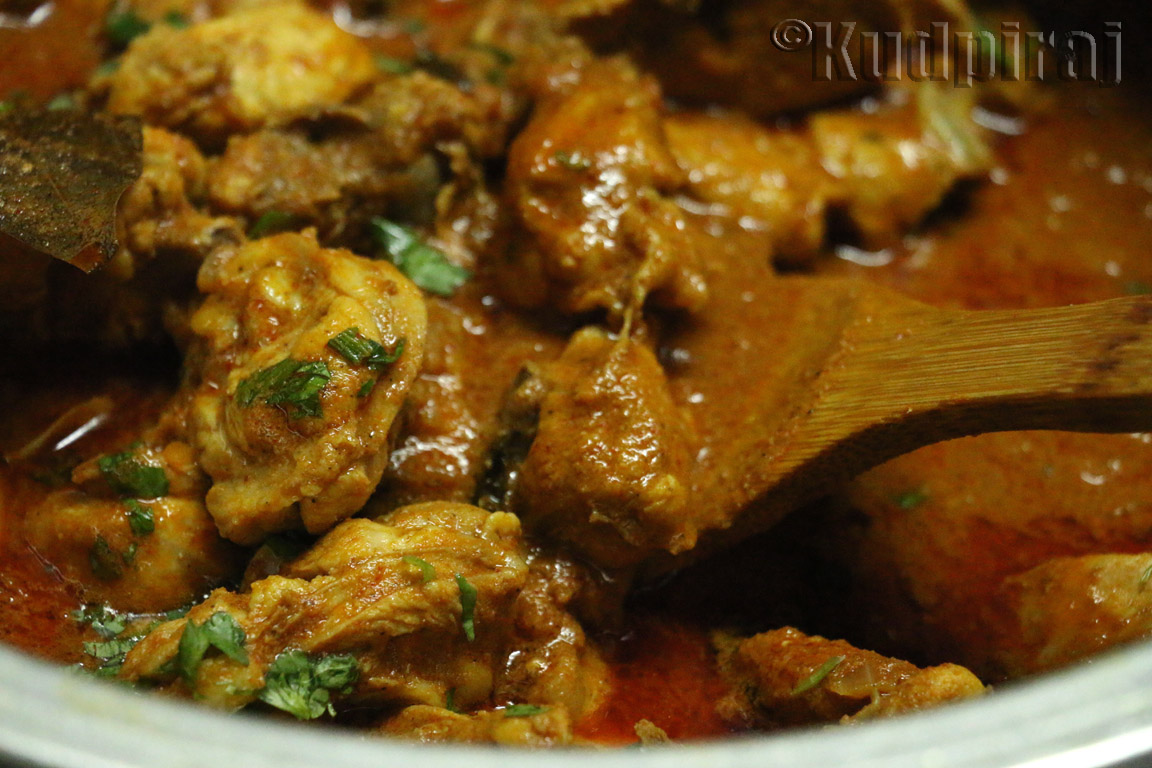
Chicken Chettinad

As per Wikipedia, Chettinad cuisine is the cuisine of the Chettinad region of Tamil Nadu state in South India. The Chettiar community, who are a majority in this region, are a very successful trading community. Chettinad cuisine is one of the spiciest and the most aromatic in India.

Chettinad cuisine is famous for its use of a variety of spices used in preparing mainly non-vegetarian food. The dishes are hot and pungent with fresh ground masalas, and topped with a boiled egg that is usually considered essential part of a meal. They also use a variety of sun dried meats and salted vegetables, reflecting the dry environment of the region. The meat is restricted to fish, prawn, lobster, crab, chicken and lamb.

Most of the dishes are eaten with rice and rice based accompaniments such as dosais, appams, idiyappams, adais and idlis. Here is Chicken Chettinad, my personal favourite curry for the viewers with recipe from Chef Sanjeev Kapoor's Khaana Khazana, slightly changed according to my taste.


Ingredients:
Chicken - 1kg
Poppy seeds - 2 tsp
Grated coconut - 1/2
Fennel seeds - 1 tsp
Coriander seeds - 1 tsp
Cumin seeds - 1/2 tsp
Whole red chillies - 8(3 long and 5 short) 
Cinnamon - 1" stick
Green cardamom - 3 
Cloves - 2 no
Peppercorns - 1/2 Tsp

Ginger, chopped - 2 tsp
Garlic, chopped - 2 tsp
Curry Leaves - 1 sprig
Bay leaves - 1-2
Onion, large - 1
Tomatoes, medium - 3
Star anise - 1/2
Red chilli powder - 1/2 tsp
Kashmiri chilli powder - 1 tsp

Turmeric powder - 1/2 tsp
Lemon - 1
Fresh coriander - A handful chopped
Oil - 1/2 cup
Salt - To taste

Method:
Clean the chicken, remove the skin and cut into medium size pieces.
Chop the onions and tomatoes separately.
Roast the whole red chilies, grated coconut, poppy seeds, coriander seeds,cumin seeds, peppercorns, green cardamom, cloves, cinnamon, star anise, fennel seeds in oil and grind to a paste along with ginger and garlic.
Heat oil in a vessel and fry the curry leaves and bay leaf followed by onions till golden, then add the ground paste and sauté for some time.
Add the tomatoes, chilli powders, turmeric powder and sauté.
Add the chicken, mix and cook for 5 minutes and then add 2 cups of water and lemon juice.
Cover and cook till the chicken is done.
Serve hot garnished with coriander leaves.

LinkWithin

Related Posts Plugin for WordPress, Blogger...

Image Copy Control